









Director of Operations and Commercial Pilot for Roraima Airways, Captain Learie Barclay took the stand at the MV Barima Commission of Inquiry this morning and told the Commission that emergency flares were first sighted at 2:09am on July 19, 2026, approximately 3 nautical miles away from the coordinates initially received regarding a vessel in distress.
That was almost four hours after the distress signal was initially received.
Captain Barclay along with Captain Gerry Gouveia Jr. and Christopher Chung had flown out to the Essequibo Coast just off Hampton Court after receiving the coordinates from National Security Advisor Captain Gerry Gouveia Snr, who is the founder of Roraima Airways.
The Commission heard that due to there being a low tide at the time, the rescue aircraft were flown approximately 3 nautical miles outward, and it was then that the first emergency flare was sighted.
“I think it was a bit of luck involved here because it was the first line that we flew and it was the correct line. So, I think it was a bit of luck involved there. We got it right on the first line. Because sometimes you could be flying back and forth in a grid before you get it. And shortly after Christopher Chung shouted flare, and at the same time we saw it. And we immediately circle overhead and then a second flare and then a third flare,” Captain Barclay explained.
Captain Barclay, a pilot for approximately 36 years, had travelled to the location with two of his colleagues from the privately-owned Roraima Airways on the instructions of Captain Gerry Gouveia Snr.
He told the Commission that once he was contacted just after midnight, he hurried across to the Airport at Ogle where he was met by the other two pilots and by 1:36am, they departed to assist in the search operations.
He testified that at around 1:56am, the crew arrived in the search area in the vicinity of Hampton Court and it was from that location they saw what appeared to be flashing lights out in the ocean.
Captain Barclay said during the flight, he switched to a distress frequency, and it was not long after that they detected a strong Emergency Locator Transmitter (ELT) signal.
“I switched to 1-1-5 and at that point I didn’t know if it was a beacon. It was just let’s see, if we find something here and immediately detected a strong ELT signal. So, we continued on that line because the signal kept getting stronger and stronger and stronger,” he explained.
It was at that point that the first emergency flare was sighted, followed by the second and the third.
“We expressed concern in the cockpit, grave concern because the flares were very bright. We saw nothing of consequence on the sea. So, the flares lit up the area. We were expecting to find something. We were looking for a ferry, a reasonable size boat and unfortunately, we saw nothing of consequence,” Captain Barclay said.
Captain Barclay told the Commission that Air Traffic Control was immediately notified that they had located the vessel. The coordinates were also provided to MARAD, and they departed for Ogle, arriving at 2:37am.
Captain Barclay said he briefed President Irfaan while Captain Gouveia Jr briefed Captain Gouveia Snr simultaneously. It was noted that on their way back, they learned that a number of survivors had been found.
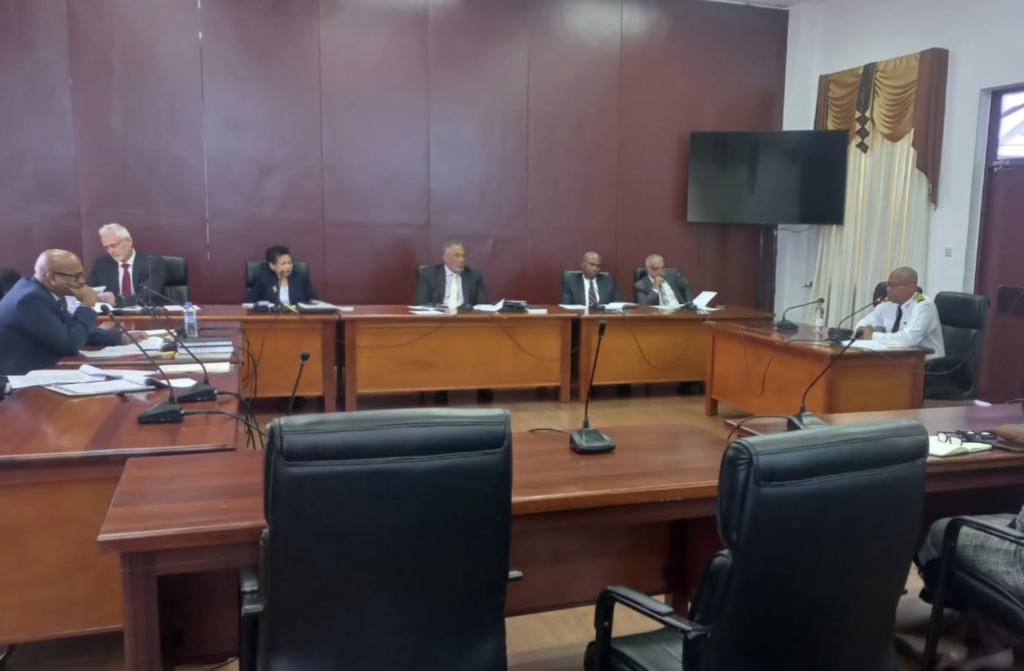
Barclay also told the Commission that that the crew did the best it could have in the circumstances, as he responded to a number of questions posed by Rear Admiral (Re’d) Hayden Pritchard in response to possible recommendation.
Commissioner Pritchard challenged him on that, pointing out that while he was contacted at 00:16am it was not until 01:36am that the aircraft departed the Ogle for Hampton Court. It was suggested that the response time could have been improved.
Meanwhile, Commissioner Dr Andrzej Jasionowski inquired as to why Captain Barclay, having returned to Ogle and refueled, did not return to the identified area to assist with the search operations.
“The thought process, my thought process at least was that once the area had been located that a number of vessels would go out and search that particular area. At that point I did not have the benefit of numbers of persons or so on. So, at that point I figure that once we had found where it was that the vessels would respond and search the area because at that point it was not much more we can do. Because when you are doing this at night over water, you are just doing this in pitch black,” Captain Barclay explained.
He said considering the resources that were available at the time, there was not much more that could be done, insisting that it would have been effective for the boats to return to the location.
However, he admitted the requisite technology, including infrared equipment, needs to be acquired to assist in nighttime search and rescue operations.
Related posts:
 Lone AIS Officer on duty dealt with multiple distress alerts from US Control System as MV Barima sank
 MV Barima’s Emergency Alert Beacon was unregistered -Commission of Inquiry hears
 MV Barima Commission of Inquiry hears of multiple engine troubles encountered by ferry before sinking
 27 confirmed dead with 83 still missing in MV Barima ferry tragedy

You must be logged in to post a comment Login