






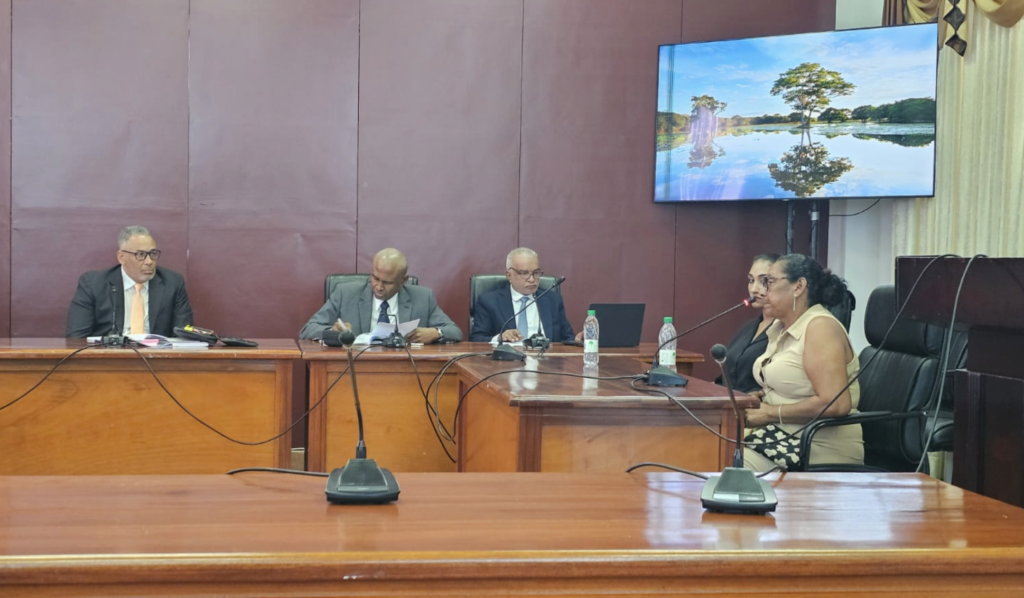
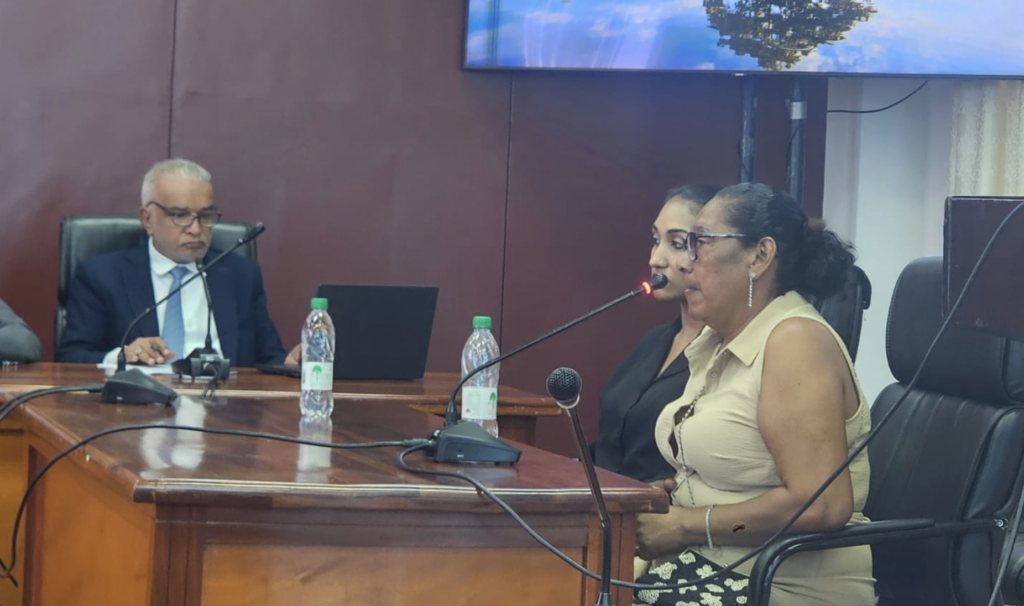
The MV Barima Commission of Inquiry hearing heard from one of the first survivors today, Helena Moonsammy, who testified that she held on to a box along with another survivor, and spent more than nine hours drifting in the rough waters of the Atlantic Ocean before they were rescued by a fishing boat after the ferry sank on July 18.
As she appeared before the Presidential Commission of Inquiry (COI), Moonsammy recounted the horrifying moment the ferry capsized and sank just off the Essequibo Coast, killing more than one hundred passengers and crew members.
Four of her grandchildren, including a two-year-old baby who remains missing, were among those killed.
Moonsammy, together with three of her grandchildren and one of her nieces survived the ill-fated incident.
Testifying alongside a state psychologist, Ms. Moonsammy testified that a single wave appeared to have caused the vessel to capsize, though it was taking in water earlier in the night.
“When this boat mek a cant, that’s when I looked to the life jackets. And this boat couldn’t go back because I hear the vehicles them were at the bow, all that slipped on the one side and the boat toppled, fast. And that’s the last thing I hear, children scream. Ah hear nuff screaming with the children them, that does hurt me sometimes. Some of them went close to me, the baby all I couldn’t save. Everybody had to fight for survival,” she recalled.
At the time of the incident, Moonsammy along with her grandchildren and niece were on the second deck of the ferry.
According to her, five of her grandchildren were in the middle section of the boat sleeping on the floor, while three others were with her, including a two-year-old baby.
Moonsammy said it was another passenger on the ferry who informed her that the vessel was sinking.
She was lying on a bench at the time, and said she immediately got up to grab all of her grandchildren, but as the vessel capsized, a crate of boxes fell on her and the baby, pinning them both.
“We get trapped. I tell you boxes cover me down. I had to rev, rev and I mek way to come up and when I feel the top of the boat, you know the back. My head jam the back of the boat but under water. So, I had to tek my hand and I feel and I mek way and pull out myself. I fighting coming up because I can’t swim. I hold my breath up to certain time but I couldn’t hold it no more, I had to start drinking water, and I started praying in that water, if that’s the way I am going to dead because I see death,” Moonsammy told the Commission.
Moonsammy said she and another survivor held onto a floating box for hours before help came.
“I get rescue like close to 7 o’clock in the morning because is me and a lady hold on a box that’s how the two of we survived. Ah fishing boat is what rescue we. We were rescued by some fishermen and when I asked them the time, the sun de already hot, and where they rescued we there was no shore, no bush. So I don’t know where we were headed. We get rescued late. If I had like a half hour more to go, I wouldn’t ah mek it because my foot de done de cramp, and is just this hand de left. I average about nine hours soaking in that water,” the survivor told the Commission.
Once rescued by the fishing boat, Moonsammy said she was transferred to two Guyana Defence Force (GDF) Coast Guard vessels before being taken by another boat to Charity for medical attention.
Before Tragedy Struck
In the hours leading up to the tragedy, Ms. Moonsammy recalled arriving at the Transport and Harbours Goods Wharf in Kingston around 10am with her seven grandchildren and niece to board the vessel.
The MV Barima, she testified, was scheduled to depart at 1pm on July 18, 2026.
Moonsammy had traveled on the MV Barima at least three times per year for the past 15 years.
She testified that although she had purchased a total of nine tickets for the trip, on the day of the incident, she was not required to show those tickets before boarding.
Moonsammy said the vessel was extremely packed with cargo and people, and by heer estimate, there were more than 200 people on board.
She said she opted to take her grandchildren and niece to the second deck of the vessel, where they settled in on the floor.
“They had like box and suh pack on the long bench. So, bags and box were packed on that bench, and these kids had to go on the floor. We couldn’t fight them because that’s normal thing,” she said.
Moonsammy recalled that after the vessel set sail, one of the sailors alerted the passengers on the second deck that the voyage would be approximately 17 hours with nine of those hours to be spent in “rough waters.”
She told the Commission that at the time, the life jackets onboard the vessel were not accessible, as they were locked away in a cage-like structure at the top of the boat.
Moonsammy also testified that during the voyage, there were people drinking on the lower deck near the canteen, including at least one crew member, who she said did not survive the tragedy.
“They had no other people passing around checking passengers or checking the boat. They were sporting to be honest. They were sporting downstairs. The canteen don’t open so late; I don’t know why that night the canteen opened so late. That music, they sport until the boat turn over,” Moonsammy testified.
Moonsammy told the Commission that the captain of the vessel should have had the sailors constantly checking the vessel, and passengers should have been informed that they were in danger as soon as they realized the vessel was taking in water.




You must be logged in to post a comment Login