









By Svetlana Marshall
The European Union Election Observation Mission presented its final report of the 2025 elections in Guyana and called for Constitutional reform to strengthen the country’s electoral system.
The EU team made 18 recommendations in the report, which cover aspects of the country’s legal framework, the election administration, voter registration, election day, media and social media.
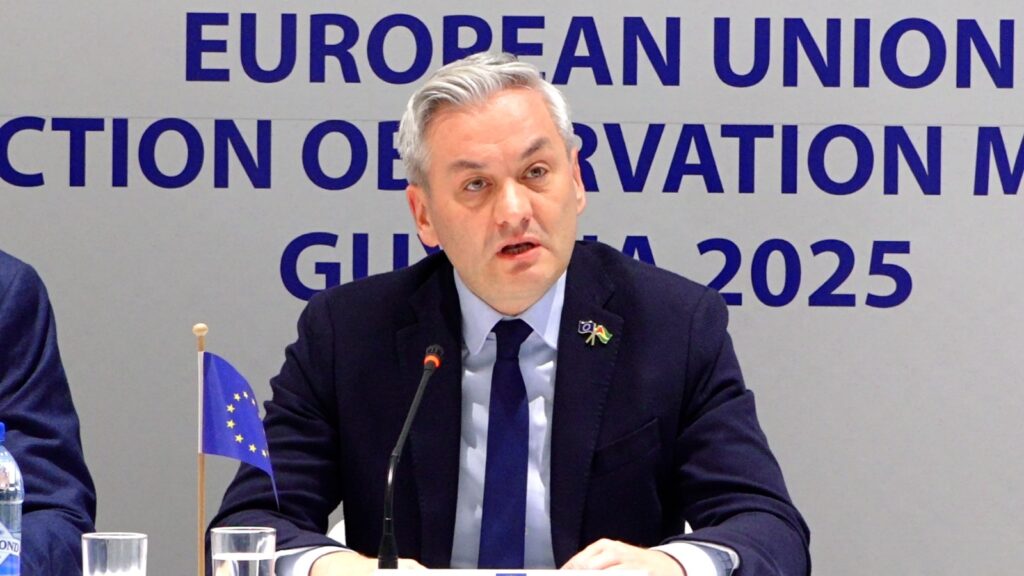
The EU Observer Mission’s Chief Observer, Robert Biedron, in presenting the final report at the Pegasus Suites, said while the country’s legal framework is broadly adequate, there is the need for electoral reforms at the level of the Constitutional Reform Commission (CRC) to address, in particular, the composition of the Guyana Elections Commission and other critical electoral matters.
“During our mission many stakeholders told us that they were waiting for the Constitutional Reform Commission to start its work. The CRC has a legal mandate to consult on and propose electoral reforms – supporting this year’s CRC’s process with solid electoral and legal expertise could be the key to driving a well framed future electoral reform of a constitutional nature. Therefore we recommend to enhance the prospects for key electoral reform through necessary electoral expertise as part of a robust CRC operational framework,” Biedron submitted.

Justifying the need for electoral reform and by extension Constitutional reform, the EU Election Observer team pointed to the Guyana Elections Commission, noting that it was a constitutional body with a partisan framework that splits the Commission into opposing sides in the National Assembly.
However, at present, the Commission which was appointed between 2007 and 2022, does not reflect the changing configuration of the National Assembly. Further, it precludes broader inclusion and according to the EOM, risks inefficient decision making.
The Chief Election Observer also made a case for the Voters’ List to be updated. It was explained that the accuracy of the Voters’ List was the subject of concern among the opposition parties linked to the lack of reliable population data.
It was noted that to date the 2022 Population Census Report has not been made public without exploration.
“Secondly, we heard repeatedly that people did not fully trust the Voters’ List especially because there was no recent census data, and a comprehensive way to remove deceased persons including and or those who died abroad. Updating the list using the most recent population statistics and data from all relevant state agencies and institutions, and linking these to ongoing digitalization efforts could enhance confidence overall,” Biedron said as he called for the Voters’ List to be updated.
It was explained that while the amendments to the National Registration Act in 2022 provide new mechanisms for the removal of deceased voters through reporting from the General Register Office, Police, and the Ministry of Health, there was no mechanism in place for the incorporation of information from the Police and Ministry of Health.
Another recommendation has to do with the use of state resources.
Biedron said there is need for the country to adopt clear and comprehensive campaign rules, including for the conduct of public officials and for the use of all types of state assets to avoid undue advantage of incumbency.
“In those elections, we saw how the line between state and party was often blurred. For example, public projects inauguration or government social programmes were used in ways that clearly supported one party. State vehicles were observed transporting supporters to campaign events. Government social media channels supported PPP/C campaigns. Clear and forcible rules for how public officials use state resources and government communication can be used in election period… We therefore recommend to adopt clear and comprehensive campaign rules, including for the conduct of public officials and for the use of all types of state assets to avoid undue advantage of incumbency,” the Chief Observer said.
As part of its list of recommendations, the EU EOM also underscored the need for campaign financing legislation to be strengthened and for there to be an independent oversight body that would revise outdated legal provisions, including expenditure ceilings and permissible expenses; the establishment of media campaign coverage rules on equitable airtime and space for electoral contestants as well as political advertising; and the implementation of the Data Protection Act.
Overall, the EU EOM found that the country’s election was peaceful and well run, but took place in a context of deep political polarization.






You must be logged in to post a comment Login