






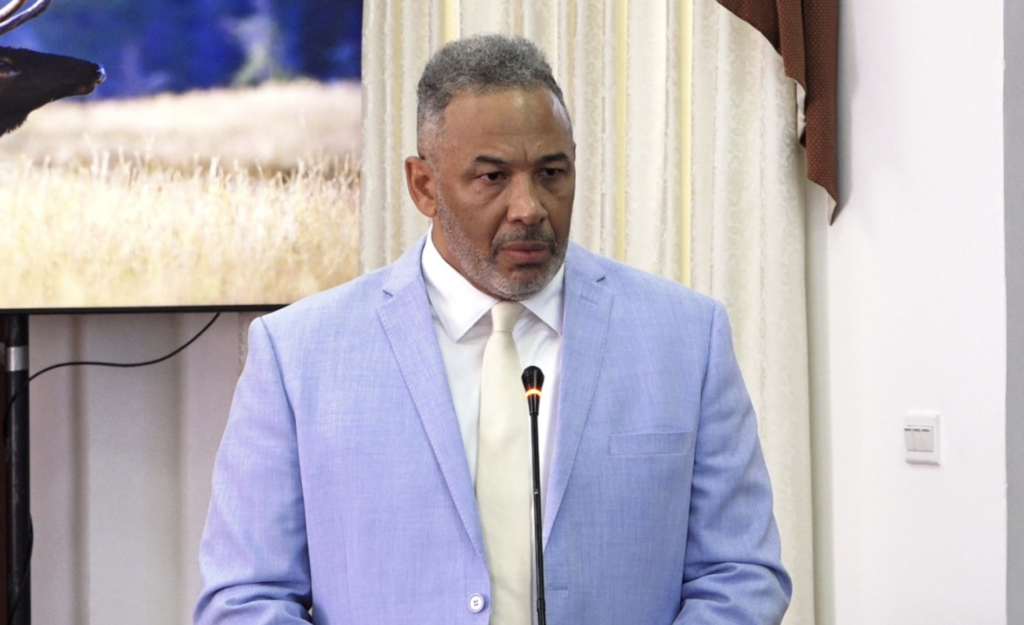
Chairman of the MV Barima Commission of Inquiry (COI), Senior Counsel Godrey Smith, today said President Irfaan Ali has rejected his offer to resign from the Commission in light of a decision by the U.S Government to revoke his visa.
Smith, who is from Belize, announced on Monday that he was informed by the US Embassy in Belize that his visa had been revoked.
“The professional thing to do because it is not my decision, I didn’t appoint myself, someone else appointed me, the president, is to inform him of what had happened and to offer to him to resign in the event he believes that it could in any way hinder, hamper, taint my role as Chairman of the Commission and he emphatically declined the offer,” Justice Smith told reporters.
Smith was appointed by President Ali in July to lead the Commission of Inquiry into the MV Barima ferry tragedy that claimed the lives of more than one hundred persons.
Senior Counsel Smith said while the U.S Embassy in Belize has confirmed the authenticity of an email he received on Monday indicating that his visa was revoked, no further information was provided.
“They confirmed that indeed the State Department had issued that revocation. But there was no further information that they could provide. I asked if there was anybody at all that I could reach or call to get details or some information as to the basis or reasons for that, and I was told no, there was no further information,” Justice Smith said.
However, he suspects that the U.S Government’s decision to revoke his visa is linked to his close ties with China, and the programmes he has been spearheading with China through the University of Belize.
“In my mind, the only, the only, and I stress only conceivable thing that I could have done to draw the ire of the United States Government is to have engaged in my capacity as Chairman of the University of Belize, in collaboration with Bejing, the Government of China. And what did that collaboration look like, you may ask and why would it lead to or raise the ire of the United States. The collaboration was basically at two levels, one attempting to engage in academic exchanges between highly reputable distinguished academics from University of Fudan in China, in panel discussions through the University of Belize, and more importantly, and perhaps tellingly, I have been sending young leaders on study tours to China including parliamentarians, at least one parliamentarian,” Justice Smith explained.
He reasoned that while many countries in CARICOM have strong robust diplomatic relationships with China, Belize is among three countries in the Regional Bloc that do not have bilateral relationships with China, but rather with Taiwan, which China sees as a breakaway province.
He suspects that the U.S might be up in arms against his work, which could be seen an expansion of China’s footprint in Latin America and the Caribbean.
Smith has made it clear that he will not appeal the decision of the U.S to revoke his visa.
“I do not wish to appeal the decision. I do not wish to reapply for a United States visa. I accept their decision and will move on from there,” he told reporters.
However, he said he would welcome a decision by the U.S to state the reasons for the revocation but said he would not be chasing down the matter.




You must be logged in to post a comment Login