






ExxonMobil Guyana has replaced a section of the gas pipeline following “an anomaly” that led to a nitrogen leak.
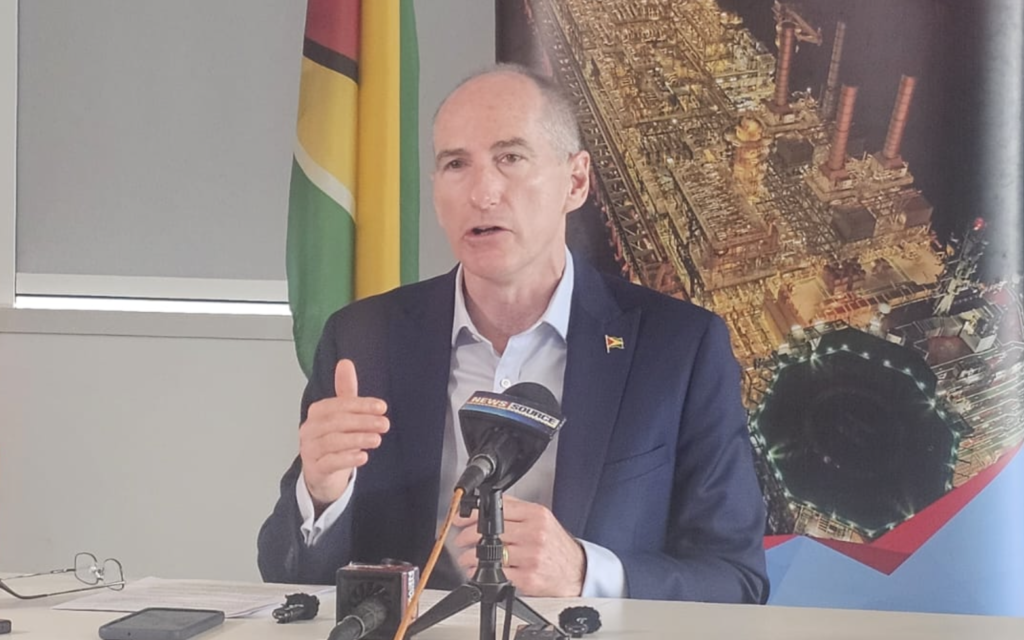
President of ExxonMobil Guyana Limited, Alistair Routledge made the disclosure this morning during a press conference at the company’s Ogle Head Office.
“Earlier this year, we did some initial inspection, installed a clamp on that section of the pipeline to ensure it had its integrity. And then, in the last few weeks, we came back with some additional equipment and some new pipe, and we removed a section of the pipe. Did some more inspection, replaced that section that had the anomaly, so that we’re confident it has its integrity,” Routledge told reporters.
According to Routledge, the section of the pipeline, which was replaced, is approximately 200 meters in length.
The anomaly on the 12-inch pipeline, which forms a critical part of the Government’s Gas-to-Energy Project, was detected earlier this year. However, it was only made public after the Leader of the Opposition, Azruddin Mohamed alleged that a section of the billion-dollar pipeline, which was completed since October 2024, had ruptured.
The Environmental Protection Agency (EPA) and the Maritime Administration Department (MARAD) subsequently disclosed in July that a “slight anomaly” was observed on the gas pipeline. Months later, ExxonMobil indicated in October that it was set to undertake pipeline maintenance activities offshore of Crane, West Coast Demerara from October 14, 2026 until around December 1, 2026.
Without offering much details, the oil company said the maintenance was intended to address “a finding on a near-shore section of the pipeline identified by inspection activities” earlier in the year.
Today, the ExxonMobil Guyana President disclosed that there was no risk to the public or the environment because of the nitrogen leak.
“So, there was a leak of nitrogen from the pipe. As we said before, this is inert, so, it is safe, no impact to the environment. But clearly, that’s not a condition that the pipe can operate in with gas in it. So, we need to really understand why that happened and what do we need to do in order to ensure that it does not happen at any point in the operating life of the pipeline,” he explained.
He said even as Exxon continues to investigate the anomaly, the pipeline remains intact and full of nitrogen. However, he was keen on pointing out that the level of exposure was “very low.”
“The line is still full of nitrogen and inert. It’s in a safe state, and so we’re taking those samples of the pipeline, the additional data that we’re gathering, taking the material to laboratories in the U.S. and continue our investigation into that issue. Our focus is on ensuring this pipeline is first of all ready for operations when the gas plant is, but secondly that it has its long-term integrity,” Routledge said.
Noting that the investigation will determine the cause for the anomaly, Routledge said Exxon will continue to inspect and assess the pipeline. He said Exxon wants to ensure that the gas pipeline maintains its integrity throughout the lifespan of the multi-billion dollar Gas-to-Energy Project.
Exxon has repeatedly indicated that it remains committed to conducting its operations safely, responsibly, and in compliance with applicable regulatory requirements.
Related posts:
 ExxonMobil to undertake maintenance activities of gas-to-shore pipeline to address undisclosed “finding”
 EPA and MARAD deny claims of ruptured gas-to-energy pipeline, but admits to “slight anomaly”
 ExxonMobil completes US$1 Billion pipeline for gas-to-energy project
 Guyana to pay ExxonMobil US$55M per year for 20 years for gas-to-shore pipeline


You must be logged in to post a comment Login