









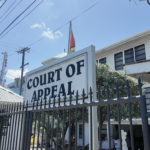
The Court of Appeal intends to issue a number of orders and directions for the hearing of an appeal brought by the Leader of the Opposition and Businessman Azruddin Mohamed, and his father challenging sections of the High Court ruling on the constitutionality of the Fugitive Offenders Act.
Those orders and directions will be issued tomorrow.
Acting Chancellor of the Judiciary, Justice Roxane George made the announcement in Court today after hearing arguments on a new motion filed by the father and son, who have been indicted by the US and are facing an hearing.
Through their Attorney, Senior Counsel Roysdale Forde, the Mohameds have filed a motion seeking a number of orders, including a stay of the extradition proceedings in the Georgetown Magistrates’ Court until the hearing and determination of the substantive appeal. The appellants are also asking for the urgent hearing of the appeal.
Their appeal challenges aspects of a ruling handed down by Acting Chief Justice Navendra Singh in February, in which the High Court ruled that while Sections 8 (3) (B) of the Fugitive Offenders Act is inconsistent with the Constitution, the other sections challenged by the Mohameds are in keeping with the Constitution.
The ruling ultimately paved the way for the extradition hearing to continue in the Magistrates’ Court before Chief Magistrate, Judy Latchman.
In the Court today, Forde told the panel of judges comprising of Justice George, Justice Rishi Persuad and Justice Nareshwar Harnanan that the Court is not being asked to decide the appeal, but to ensure that the appeal and the appellant’s liberty survive to the date on which it is decided.
He argued that his clients fear that unless the substantive appeal is heard, determined and granted, the Magistrate could rely on the “erroneous determinations” made by the High Court Judge and the amendments passed in the Fugitive Offenders (Amendment) Act in arriving at her decision.
Forde maintained that parts of Section8 (3) (A) and (B) of the Fugitive Offenders Act are in violation of Article 122 (A) of the Constitution on the grounds that they empower the Minister to order the extradition of a person without due process through the Magistrate’s Court, and therefore impose executive control over a judicial process. According to Forde, the sections violate the separation of powers doctrine.
But Attorney General Anil Nandlall in objecting, suggested to the Court that the extradition hearing in the Magistrates’ Court be allowed to continue without hindrance.
In his arguments, the Attorney General pointed to the recent decision of the Caribbean Court of Justice (CCJ), in which it dismissed an appeal filed by the Mohameds.
In that case, the father and son challenged the validity of an Authority to Proceed (ATP) issued under the Fugitive Offenders Act on the basis of bias.
The extradition hearing in the Magistrates’ Court is set to recommence next week Thursday.
Related posts:
 CCJ pauses extradition committal proceedings and sets April 21 for hearing of Mohameds’ appeal
 Court of Appeal dismisses Mohameds’ appeal of High Court ruling on perceived bias in extradition matter
 Court of Appeal rejects request to halt Magistrate Court’s hearing as it reviews High Court ruling in Mohameds’ extradition matter
 High Court hearing over Magistrates’ Court ability to hear extradition case begins

You must be logged in to post a comment Login