






Maritime specialist and member of the MV Barima Commission of Inquiry, Hamada Fouda of Jamaica, raised questions on Tuesday about the number of deficiencies that were highlighted in a 2024 inspection report on the MV Barima that were not rectified by November 2025.
Fouda raised the issue as he questioned the acting Marine Superintendent for Guyana’s Maritime Administration Department (MARAD), Christopher Bailey about the November 2025 report that he had conducted.
“I have some deficiencies coming from 2024 report, 2025 report, same deficiencies without any rectification happening,” Commissioner Fouda said.
Bailey’s November 2025 inspection was a follow-up inspection, but he testified that he did not use the 2024 inspection report as a basis for his follow-up report.
At the time of his inspection of the passenger vessel, there was a lack of critical documents, including the Safety Certificate, Ship Stability Documentation, Load-line Certification and other key documents.
A number of safety deficiencies, from a dysfunctional radar system to expired life-rafts and no Automatic Identification System (AIS), were also detected.
Commissioner Fouda questioned why the 87-year-old vessel was allowed to operate with “detainable deficiencies,” which are considered to be serious safety and operational failures.
“I found some deficiencies like life-rafts, expired, overdue…this deficiency is detainable deficiencies. So, the ship is not supposed to leave the port with expired life rafts,” the Commissioner said.
In response, Mr. Bailey told the Commission that at the time of the inspection, the vessel was under maintenance. However, he added that no clear instruction was given to ground the vessel until those serious deficiencies were addressed.
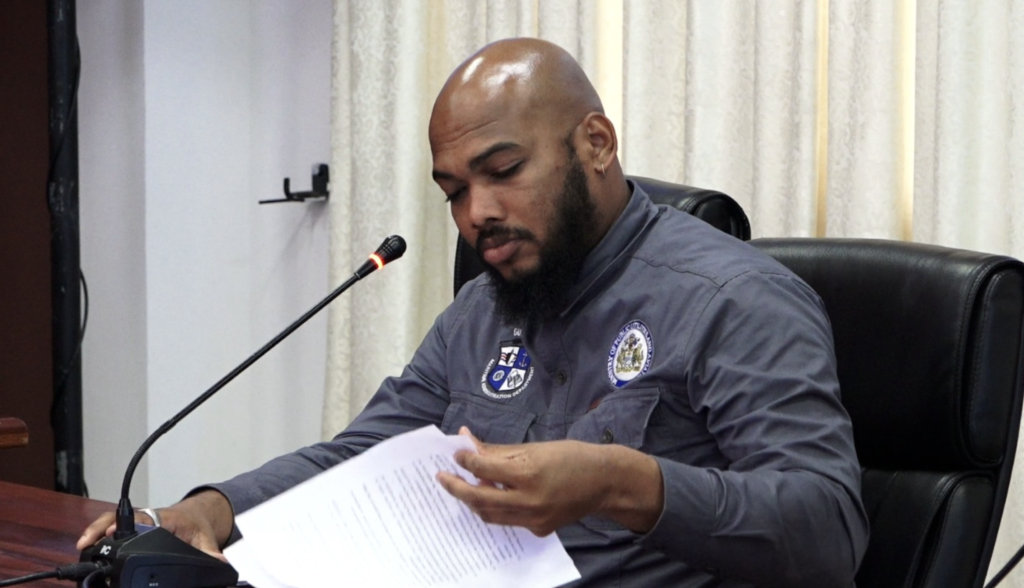
Fouda: “Did you recommend to stop this vessel until the safety deficiencies were rectified?”
Bailey: “No.”
To further compound the situation, the vessel, according to Fouda had a deficit of 5 life-rafts. Bailey had earlier told the Commission that the MV Barima had six life-rafts, however, they were out of service.
Those rafts, however, had the capacity to accommodate 25 persons each.
But Commissioner Fouda said by the International Convention for the Safety of Life at Sea (SOLAS) standard, the vessel, which had the capacity to carry 125 persons, needed five additional rafts.
“According to SOLAS, you have to have full capacity inside the vessel. So now I need, 274 spaces for life rafts. So that means, I have five life rafts missing. If I have six, in addition to this six, I need five,” Commissioner Fouda said, with Bailey responding in the affirmative.
According to Bailey, the more than 200 life jackets that were onboard the vessel had no lights. Additionally, the vessel had two engines but only one was operational.
Commissioner Fouda also flagged the lack of critical certificates.
“Certificate of Inspection or Passenger Ship Safety Certificate – according to the Shipping Act, any ship, any passenger ship must have this certificate onboard before it departs the port. This is according to the Guyana Shipping Act. Did you see this certificate onboard? Why, you allowed the ship to sail. If the Shipping Act does not allow the ship to sail without this certificate?” Commissioner Fouda further questioned.
But Bailey maintained his position, telling the Commission that the vessel was under maintenance.
Commissioner Andrzej Jaisonowski also grilled the MARAD Marine Superintendent (ag) on the absence of the certificates, in particular the Ship Stability Documentation and the Load-line Certification.
Bailey told the Commission that though the documents were not on the vessel at the time of the inspection, the load-line was visible on the vessel. But the Commissioner, nonetheless, pressed him on the matter.
“So how do you check, how do you inspect to ensure that the load line has been respected? It doesn’t have the load certificate but it has the load-line. How do you check to ensure that the load line has been complied with by the vessel? If you don’t look at draft, what do you look at?” Commissioner Jaisonowski further questioned.
Bailey, in response, explained that the draft marks, plimsoll line and load-line were all visible at the time of the inspection. Bailey told the Commission while he did not see any load-line certificate on MV Barima, other ferries had.
Bailey concluded after his inspection of the MV Barima, which lasted approximately 45 minutes to an hour, that the vessel was in “fair condition.” His report was submitted to the MARAD’s Director of Shipping.
The vessel capsized and sank off the Essequibo Coast on July 18 killing more than 100 persons including men, women, and children.
Related posts:
 Acting Marine Superintendent testifies no reason existed to ground MV Barima despite deficiencies
 MV Barima Commission of Inquiry hears of severe shortage of Inspectors of Shipping in Guyana
 Emergency beacon that dispatched MV Barima distress signals was recovered hours after tragedy
 Three MARAD vessels responded to MV Barima tragedy from Georgetown


You must be logged in to post a comment Login