









By Svetlana Marshall
International Observers of the recently concluded elections have found that decision-making at the level of the Guyana Elections Commission (GECOM) remains heavily influenced by politicians, thereby diminishing the public’s trust in the institution.
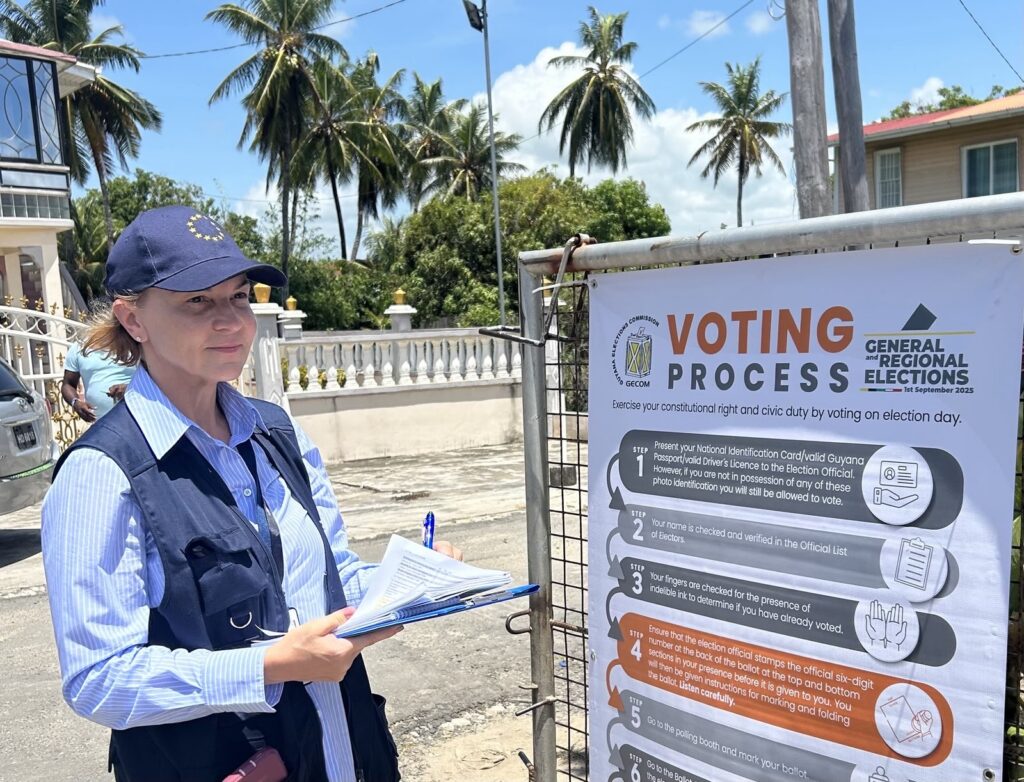
The European Union (EU), The Carter Center, the Commonwealth Secretariat, the Caribbean Community (CARICOM), and the Organization of American States (OAS) Election Observer Missions while acknowledging the smooth conduct of the September 1 General and Regional Elections, highlighted urgent need for the Elections Commission to be reformed.
Chief Observer for the European Union’s Election Observer Mission, Robert Biedron, said GECOM’s structure and decision-making remain heavily influenced by political divisions with the Commissioners often sharing conflicting information, thereby compromising an already reduced trust in the institution.
“The Guyana Elections Commission (GECOM) managed the elections efficiently, however, its decision making remains heavily influenced by political polarization, which undermines public confidence. Commission members often express conflicting stances in public which further compromise trust in the institution,” Biedron said.
Leader of the Carter Center Election Observation Mission, Jason Carter, said unfortunately the Constitution of Guyana does not explicitly establish the seven-member Elections Commission as an independent body, and the Carter-Price formula, which is used to compose the commission, is now out-dated.
Based on the formula, three Commissioners are nominated by the Government, while three are nominated by the opposition, and the Chairman is appointed by the President from a list of nominees submitted by the Leader of the Opposition.
However, Mr. Carter said that those Commissioners have been closely aligned with Guyana’s two historically dominant, ethnically based political parties.
“There is a mechanism now for selecting the GECOM commissioners, they have called that the Carter Formula; we have been against the Carter Formula for years. making these recommendations and so there are a number of ways that you can look at international best practices and understand how that Election Commission, itself, can be more independent and less partisan. And it can still be a Guyanese solution, and really, that is what it requires,” Carter said.
The Carter Center said in addition to the problems of gridlock, polarization, dominant political party control, the current structure of the Elections Commission excludes smaller parties from the electoral decision making process.
Six parties contested this year’s Elections, but the PPP and the APNU are the only parties represented on the Elections Commission.
The Carter Center said the situation leaves other parties without equal access to information about the electoral process and no voice in decisions affecting the process.
It said the structure of GECOM contributes to the lack of trust among some of the political parties and the broad public.
Meanwhile, the Chief of Mission for the CARICOM Observer team, Chief Elections Officer of Belize, Josephine Tamai said independent Commissioners need to be appointed.

“I am not certain that when it comes to the Commission, it should only be political parties involved because at some point in time, some of those political parties don’t exist anymore and so, you would want to have independent organizations being a part of the Commission. Because the complaint has always been that it is basically the two major political parties…and the other parties don’t really have a voice. I don’t believe we should just limit it to political parties,” Tamai said.
The CARICOM Chief of Mission said independent organizations should be represented on the Commission, in addition to political parties, and the appointment for all Commissioners should be time-bound.
The Commonwealth and OAS Observer Missions expressed similar concerns, with the Commonwealth stating that the present composition of GECOM prohibits the Elections Commission’s ability to effectively operate and excludes important stakeholders from deliberations and decision makings.
Similar concerns and recommendations were put forward following the 2020 Elections, but many of those recommendations remain without action.
Related posts:
 Election Observers on the ground observing polls; Preliminary reports expected by Wednesday
 Election Results will not be credible until Region 4 results establish in “accordance with law” -International Observers
 Jimmy Carter arrives in Guyana for Monday elections; US Embassy satisfied with elections preparations
 Jimmy Carter confirmed for Guyana Elections visit

You must be logged in to post a comment Login