









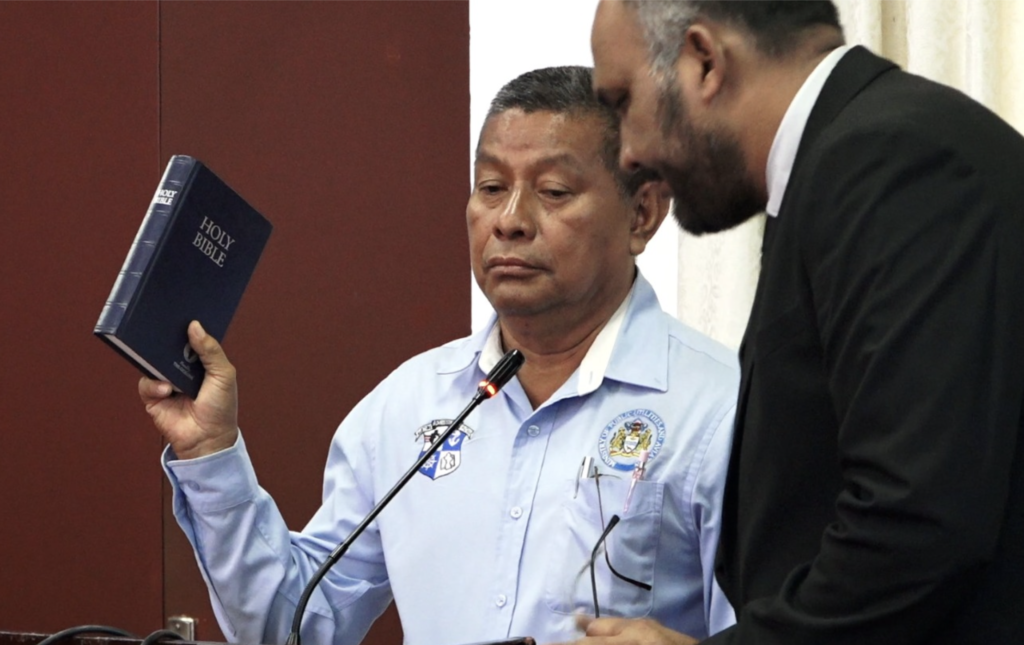
Director of the Maritime Rescue Coordination Centre (MRCC), Captain John Flores is of the view that the response to the MV Barima ferry tragedy was “reasonably well done”. More than 100 persons lost their lives in the tragedy.
Captain Flores, who also serves as the Coordinator of the Maritime Administration Department (MARAD) Emergency Operations Division confirmed to the Commission of Inquiry today that when the distress signal was first received, the authorities could not pinpoint the particular vessel that was in distress, but responded “promptly”.
“There was no delay in terms of how we operated in getting to the Coast Guard. I think it was reasonably well done. The only delay that I would think, in terms of a faster response, would have been a day light response because it was in the wee hours, and in my estimation some of the capabilities that the vessels had are not suitable for night operations. Obviously, that is something we need to correct,” Captain Flores told the Commission.
The first set of survivors were rescued more than three hours after the first distress message alert was sent to the Timehri Control Tower on the night of July 18.
But Captain Flores told the Commission that 90% of the survivors were rescued during the wee hours of July 19, 2026, and by daybreak, they were transported to Charity for medical treatment.
“There was no delay in anything. The only delay we had was because we were not sure what it was and that happens in real life all the time because you have to process to find out if it is a confirmed case. Many of the cases are fake. So, it took us a little while to confirm. Once it was confirmed or even before, they were already moving to the area to confirm,” the MRCC Director said.
Though the Timehri tower first received a distress message alert at 10:43pm on July 18, it was not until 11:03pm that Captain Flores received the alert.
That message contained coordinates and information sent from an Emergency Position Indication Radio Beacon (EPIRB), but Captain Flores said the beacon’s registration was “incomplete,” explaining that that the vessel’s name was missing and there was no information regarding the owner of the vessel.
“So, we knew where it was going off from, and we knew the time it started to go off. So, it gives us information from which we could start developing a little search plan to locate the device or where the device was attached to,” he explained.
He said within minutes the emergency response team was mobilized, and began to plot the coordinates, even as they made contact with the GDF Coast Guard, the Light House Department, Transport and Harbours and Maritime Administration.
He said at 11:23pm, he advised the Commanding Officer of the GDF Coast Guard, David Shamsudeen to deploy the Coast Guard’s closest asset located at Pomeroon to the distress location just off the Essequibo Coast to investigate the matter.
Captain Flores told the Commission that even before Rescue Coordination Centre could confirm that it was the MV Barima that was in distress, he received a call from a friend in Canada who said it was rumored that the vessel had capsized.
The Commission would then hear that a call was made to the Maritime Superintendent at Transport and Habours and it was confirmed that MV Barima was in the area where the distress signal emanated.
“One of the initial calls I made was to the Maritime Superintendent of Transport and Harbours, Derrick Erskine and he did confirm that they had left at a particular time of the afternoon. And when we plotted the distance and the speed of the boat, they would have been in that general area. My question to him was, do you know if they had capsized? He said no. At that point, he did not know. He had no contact with the vessel. So, we knew that the Barima was in that area now, and there is now a large possibility that it could be that the distress signal that is coming, could be the Barima. That caused us to put more urgency in having more response agencies go out to see if they could locate the vessel,” Captain Flores explained.
He said the information was immediately provided to the Coast Guard Commander, and by midnight, the authorities confirmed that it was the MV Barima that was in distress.
According to Captain Flores, additional assets were immediately deployed to the location.
A number of military and civilian aerial assets were also deployed to assist with the search and rescue operations.
Related posts:
 MARAD’s Response Plan should have been adequate for MV Barima incident -Captain Flores
 Lighthouse tried repeatedly to make contact with MV Barima after distress signals -COI hears
 MV Barima wreckage was located over 12 miles from initial coordinates
 GDF Coast Guard began MV Barima rescue response over four hours after distress call


You must be logged in to post a comment Login