









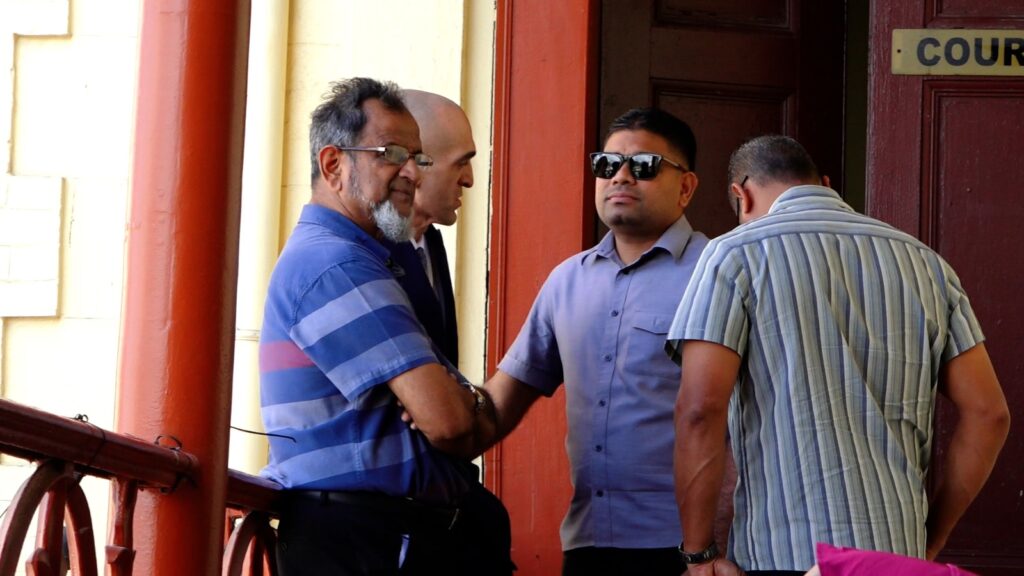
In a unanimous decision this afternoon, the Court of Appeal dismissed the appeal that was filed by the Mohameds in one of their extradition matters, which claimed bias by the Home Affairs Minister over the issuance of the Authority to Proceed with the extradition matter.
The Court found that the Minister was carrying out one of the functions of her office and there was therefore no issue of bias.
The father and son had challenged the High Court’s decision on the issue of political bias. The Court of Appeal found that the appeal lacked merit.
Acting Chancellor Roxane George in delivering the ruling of the Court said there was no evidence that the provisions of the Fugitive Offenders Act, regarding the issuance of the Authority To Proceed (ATP) were not followed.
She said there was also no evidence to suggest that the Home Affairs Minister did not follow the requirements under the Act.
“The Court holds that in the context of the Fugitive Offenders Act, in deciding whether to issue an ATP, the Minister exercise an administrative function, more so as there is no need for the subject of the request to be heard in relation to whether the ATP should be issued. Therefore, on the facts of this case, bias does not arise. It is not a case of the Minister having to make a decision between two competing parties or competing positions once the statutory provisions have been met. In carrying out this function once the Minister addresses her mind to and has complied with the statutory considerations and requirements regarding the issuance of an ATP, the ATP must be issued,” the Chancellor ruled.
The Mohameds, through their Attorneys, had argued that both the Minister of Home Affairs and the Attorney General made negative remarks against them during the 2025 election campaign and were therefore biased against them in their handling of the extradition matter.
The Court ruled that the Fugitive Offenders Act does not require the Minister to consider external issues not provided for in the legislation.
“It would be a dereliction of duty in the Minister to consider an extraneous matter in relation to what was or might have been said during election campaigning in deciding whether or not issue an ATP. The Fugitive Offenders Act does not provide the Minister to consider any other issue as she deems fit,” the Chancellor said.
Acting Chancellor George said similarly, the evidence suggests that the Attorney General Anil Nandlall provided advice to the Home Affairs Minister on a point of law, and in keeping with his functions and responsibilities.
She said there is no evidence to support a finding that such advice could be tainted with bias.
The appellants had also argued that both the Minister of Home Affairs and the Attorney General ought to have delegated their functions to others in light of the perceived bias, but the Court said they failed to indicate to whom.
The Acting Chancellor said the submissions by the appellants regarding the delegation of the Ministers’ powers lacked merit.
“There was and is no need for the delegation of powers of the Minister under the Fugitive Offenders Act,”
The appellants have signaled their intention to appeal the ruling at the level of the Caribbean Court of Justice (CCJ).
Related posts:
 Court of Appeal rejects request to halt Magistrate Court’s hearing as it reviews High Court ruling in Mohameds’ extradition matter
 Acting Chief Justice dismisses Mohameds’ challenge to extradition proceedings
 Acting Chief Justice to rule on Mohameds High Court case related to extradition request on February 2
 Court of Appeal ruling on GECOM Declaration matter is final; CCJ has no jurisdiction says AG

You must be logged in to post a comment Login