









The 57th Annual General Assembly of the Caribbean Broadcasting Union (CBU) opened last evening at the Arthur Chung Conference Centre with the Director of the Center for Media Integrity of the Americas, Ambassador John Feeley underscoring the importance of a free press to democratic societies.
Stating that there cannot be genuine democracy without a free press, Ambassador Feeley said the right to report freely is not a privilege granted by the powers that be, but rather it is a condition of democracy.
He said journalists must be allowed to ask difficult questions.
“We believe that journalists should never be required to ask permission before asking difficult questions, and governments should not expect journalists to avoid asking those questions just because they create tension and make those who might hold power uncomfortable,” the Director of the Center for Media Integrity said.
Feeley, who is a former US Ambassador, said the best test of a Government’s commitment to freedom of expression is not how it treats journalists who praise its work, but how it treats those journalists who might challenge it.
He said freedom of the press is not designed to protect a Government from embarrassment, but rather to protect citizens from the consequences of a Government without scrutiny.
“A free press is not an enemy of government. A responsible independent press is one of democracy’s most important safeguards. It can be irritating. It can be persistent. It can sometimes get things wrong. And when it does, the press has a sacrosanct responsibility to correct that record. But that is not a defect of democracy. That is democracy doing its job. Every government, regardless of its political party, its ideology, its popularity or its good intentions, has enormous power and by nature needs scrutiny,” Ambassador Feeley said.
At the time of his address, Ambassador Feeley was presenting the first CMIA-CBU Caribbean Defender of Media Freedom Award.
Belizean journalist, Jules Vasquez, was presented with the inaugural award.
The CBU’s General Assembly has brought together journalists and media practitioners from across Latin America and the Caribbean Region.
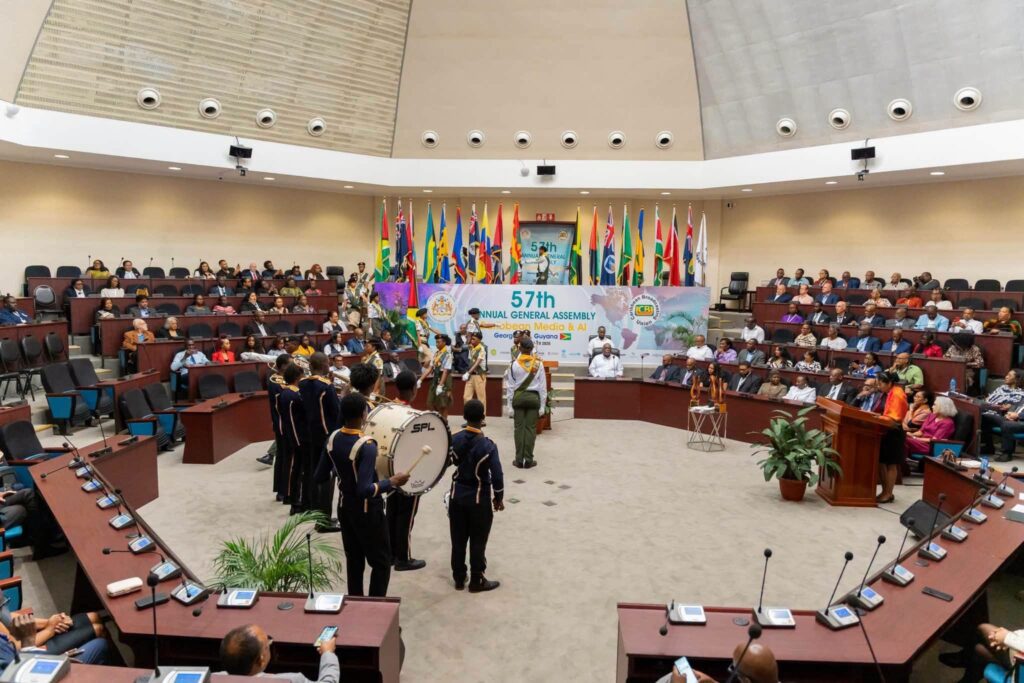
President of the CBU, Anthony Greene said this year’s theme, “Caribbean Media and A.I”, is apt, noting that already, Artificial Intelligence is changing the way media operatives gather information, produce content and reach audiences. He said while AI promises greater speed and efficiency, it also raises difficult questions about accuracy, authorship, jobs, public trust and the values that should guide its use.
“For all the promise of new technology, no tool can substitute for a sustainable business model, trusted journalism or the resources required to report consistently from and for our communities. Innovation matters but innovation without viability cannot secure the future of Caribbean media and the warning signs are before us,” the CBU President said.
He pointed to the fact that since July 2025, a number of established Caribbean media outlets have ceased operation, including Loop News, SportsMax, Eye News in the Cayman Islands; Newsday in Trinidad and Tobago and Stabroek News here in Guyana.
Greene said while their closures cannot be reduced to a single cause, they represent a sobering signal.
He said media viability is not merely a commercial concern, but is also a public interest concern.
“Viability has many dimensions: sound revenue models, audience trust, access to technology, fair and enabling policy, the safety and development of journalists, and the capacity to withstand disasters and other disruptions. Meeting that challenge will require media owners, practitioners, governments, educators, advertisers, technology companies and development partners to work together,” the CBU President said.
In his address to the opening of the event, President Irfaan Ali spoke of the importance of Caribbean stories being told by those within the region. He pointed to the increasing number of international influencers coming to the region, the evolution of technology, and way in which information is disseminated and consumed.
“The Caribbean Broadcasting Union was born from the recognition that the Caribbean needed to tell its own story. That mission has not disappeared, it has become more urgent. We now have more ways of communicating than at any time in human history. But having more ways to communicate does not necessarily mean that we are communicating more meaningfully. We have more content, but we do not have more Caribbean content. And we have more technology, but are we using that technology to strengthen the Caribbean identity? Or to dilute it? That is a challenge. Before this assembly, we should not fear technology, we should master it. We should not reject AI. We should understand it, regulate it wisely, and use it intelligently. We should not retreat from the global digital platforms. We should use them to take Caribbean stories to the world,” the President said.
Like the other speakers, the President took note of the major challenges confronting Caribbean media, including the loss of advertising revenue, the need for economic sustainability, the fragmentation and migration of audiences, misinformation, and technological transformation.
Related posts:
 Speaker uses COVID-19 measures to restrict media access to National Assembly;GPA and Journalists Condemn move
 Guyana Press Association seeks international help to address cyber attacks on journalists
 GPA concerned about possible use of spyware to monitor work of media and sources
 GPA to hold Jagdeo accountable for threats against journalists and media workers

You must be logged in to post a comment Login