









Attorneys in the ‘Election Ballot Exclusion case’ clashed today in the High Court over the exclusion of the Forward Guyana Movement (FGM) and Assembly for Liberty (ALP) from the ballots in a total of five electoral districts, with GECOM arguing that in the absence of a list for a geographical constituency, a party cannot be represented on the ballot paper.
Attorney Vivian Williams, who is representing Forward Guyana Movement Candidate, Krystal Hadassah Fisher – told the acting Chief Justice Navindra Singh that the exclusionary practice by GECOM is discriminatory and unconstitutional.
For almost two hours, Williams argued that GECOM has violated the fundamental right of Guyanese to vote. He said the procedure adopted by GECOM that omits the Lists of Candidates contesting the National Elections from ballots in certain regions, is an unnecessary burden and dilutes the weight of the votes in Regions 1, 2, 7, 8 and 9.
Dr Williams submitted that having registered to vote, some citizens are now being given the bare minimum or the basic – a limited number of parties from which to choose, while others are being given the “premium version.”
He concluded that voters do not have equal access, and his client is now unable to vote for her own party – FGM – a position he iterated outside the courtroom.
“What GECOM is doing is creating a situation where some regions of the country, just have basic access, not the premium access that some other regions have that give them greater access, that allow for greater and more robust participation in the democratic process, and that created unequal citizens. It would mean that the value of your citizenship and the extent to which you can engage in the democratic process is dependent on where you live and not the bases of your citizenship,” Dr Williams said.
He argued that GECOM’s exclusionary practice violates both the Constitution and the Representation of the People Act, adding that by omitting political parties from ballots in specific geographic regions where they are not fielding candidates for regional seats, results in an incomplete representation of voter preferences.
To support his arguments Dr Williams cited several Articles from the Constitution.
But Attorney-at-Law Arudranauth Gossai, who is representing GECOM in the case rejected the arguments put forward by applicant.
Gossai told the Court that GECOM is a creature of the Constitution, and operates within the confines of the Constitution and the Representation of the People Act.
He said contrary to the arguments put forward by Williams, GECOM is not breaching anyone’s right to vote.
Pointing to the Representation of the People Act, Gossai submitted that “GECOM can only include on the ballot paper for the geographic constituencies, those Lists of Candidates or the political parties” that are contesting the elections in those electoral districts.
He said in the case of the Forward Guyana Movement, the party opted not to submit Lists of Candidates for Regions 7, 8 and 9, and as such, it has not qualified for a vote in those regions. Gossai told the Court that is no fault of GECOM.
“The ballot is cast for a geographical constituency list simultaneously with the national top up list. So, if you choose not to field a list of candidates in the geographic constituency, how are you blaming GECOM for that?” he said.
Further, he questioned from which Lists of Candidates would names be extracted from, were FMG to win seats in the three regions, were it to be included on the ballots.
“Where are they extracting those names from? It has to be from the Geographic Constituency,” he said, while pointing out that in the case of FGM, it has no list from which to choose.
“If you don’t have a list, you can’t go on the ballot,” Gossai submitted.
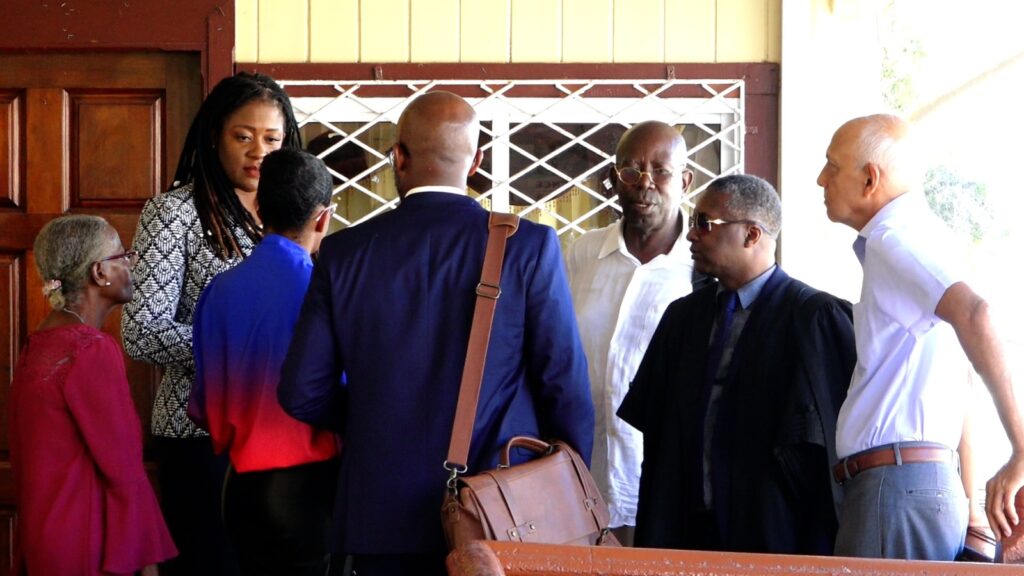
The Attorney General, Anil Nandlall – an added party in the matter – echoed similar arguments but went at lengths to outline the historical evolution of Guyana’s electoral system taking into consideration the constitutional changes.
Addressing the issue of contention, the Attorney General argued that for the purpose of General and Regional Elections, Guyana is divided into 10 geographic constituencies for the purpose of election of persons from those constituencies.
He said eligible Guyanese can only participate in the electoral process if they are registered to vote.
He said in the case of applicant, who is a resident of Region 9, she is not being denied the opportunity to vote. However, she would only be able to vote for the options available on the ballot – meaning the parties that have submitted Lists of Candidates for her geographic constituency.
Nandlall said while FGM surpassed the minimum requirement of contesting the General Elections in seven regions, it opted not to contest the election in three regions, and GECOM cannot be faulted.
Outside the courtroom, he told reporters that it is clear that Dr Williams and his client do not understand the electoral system.
“The system has its peculiarities as does every electoral system. The system ensures that every elector is allowed to exercise their respective franchise but obviously, if you want to exercise your franchise for a particular party, that party must be participating in the elections. And the system is structured in such a way that the geographic constituencies are 10 in number across Guyana, a vote in the geographic constituency is a vote that is also counted for the national top up list,” he said.
The case, which is being observed by a number of international observers, will continue tomorrow in the High Court where Dr Williams will be given the opportunity to respond to the arguments put forward by both GECOM and the Attorney General.
Related posts:
 High Court set to hear arguments in Election Ballot Exclusion case on Tuesday
 Forward Guyana Movement moves to Court over exclusion from General Election Ballot in three Regions
 Forward Guyana Movement questions GECOM’s request for modification of party symbol
 Attorneys argue Magistrates’ Court has no jurisdiction in hearing extradition case

You must be logged in to post a comment Login