









Guyana’s Agent in the border case against Venezuela before the International Court of Justice, former Foreign Minister Carl Greenidge, today explained that Venezuela has always been inconsistent in its position on the border issue and its bilateral relations.
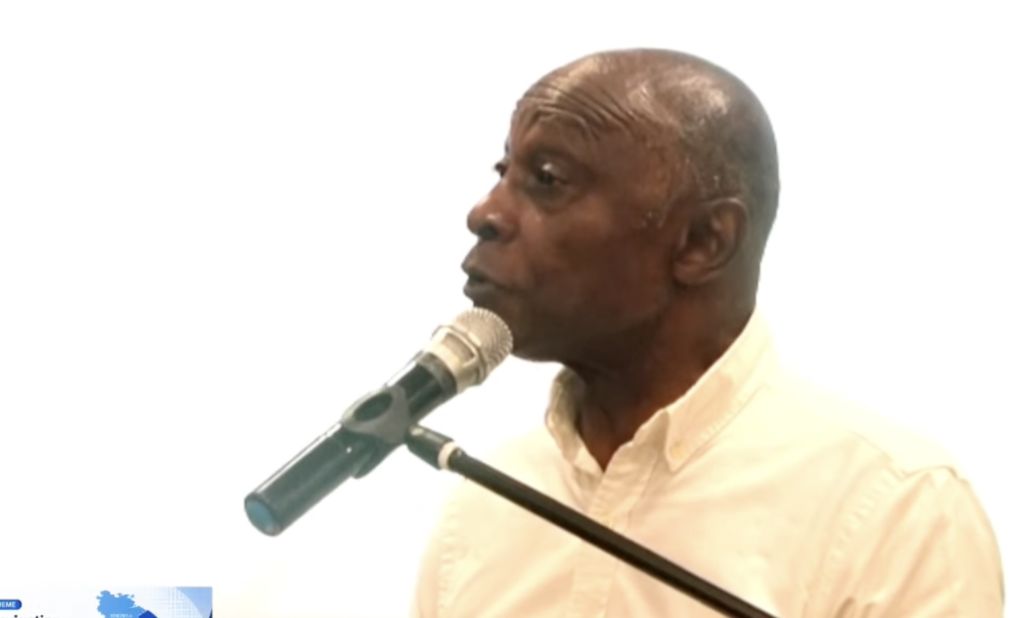
Speaking at the conference being hosted by the Centre for International and Border Studies here in Georgetown, Mr. Greenidge said Venezuela’s shifting of the goal posts over the years on the border issue, is not strange.
“One of the things that people have difficulty with… is what appeared to be a moving of the goal posts all the time as we deal with Venezuela. So one of the features of Venezuela and Venezuela’s bilateral relations is the inconsistency of Venezuela. If this sounds like bilateral bias, let me say to you, the problems that we encounter in terms of relying on Venezuela’s word or agreement to things, is not peculiar to us. Between Venezuela and Colombia, they have several agreements over the years. In the 1940s, earlier 1950s, which Venezuela now disputes. Venezuela disputes after agreements. So we are not, we are not alone in this plight of a neighbour whose word and treaties seem not to hold any value as far as they’re concerned”.
Mr. Greenidge formed part of Guyana’s team that recently put forward Guyana’s case at the International Court seeking a final and binding settlement of the border dispute. The border issue was settled in 1899, but six decades later, Venezuela reignited the issue while claiming that there was fraud in the Arbitral Award that settled the dispute, although it had agreed to the award.
Over the years, Guyana has faced various acts of aggression, threats and intimidation from the neighbouring country as it continued to claim more than 70% of Guyana’s territory. Even after Guyana moved to the International Court in 2018 on the advice of the United Nations Secretary General, Venezuela continued with its acts of aggression.
There was the case of Venezuela holding sham elections for a Governor of Guyana’s Essequibo region and also Venezuelan navy boats making their way into Guyana’s waters to question the captains of the oil ships operating in Guyana.
Many of the issues were raised during Guyana’s presentation before the International Court. Mr. Greenidge also explained today that while Guyana maintains that the border dispute was settled in 1899, the issue remains a dispute before the International Court for its adjudication.
“We have gone to the International Court of Justice, and once the International Court of Justice is dealing with this matter, it becomes, as it was at the beginning, it becomes a dispute. Because the court, if it is to resolve a problem, has to recognize a dispute. They don’t deal with controversies. Too big for that. They’re giving a definitive answer, unless you’re asking for an opinion, they’re giving a definitive answer to a problem that two members face. So it is a dispute for purposes of our discussion and for purposes of the Court, until such time as the Court pronounces, hopefully at the end of the year, this will be a dispute, and a process of resolving the dispute. When the Court will have pronounced, we will then, be able to abandon the title or the nomenclature of dispute”, he said.
Venezuela has said it still does not recognise the International Court of Justice having the jurisdiction to pronounce on the matter and it prefers discussions between the two countries. The Court’s decision will be both binding on Guyana and Venezuela.
Related posts:
 International law will continue to be Guyana’s armour in border controversy with Venezuela -President Ali tells UN
 Guyana rejects Venezuela’s arguments in border case; Greenidge says Venezuela’s arguments meant to derail process
 Greenidge unlikely to take up MP post because of border case -Sources
 Venezuela has time to change its mind and participate in ICJ hearings in border case -Greenidge

You must be logged in to post a comment Login