









The 2026 Law Year opened this morning with a special sitting of the Full Bench of the Supreme Court with the Acting Chancellor of the Judiciary, Justice Roxane George recommitting the Judiciary to a service of excellence in keeping with its Strategic Plan.
A recent International Framework of Court Excellence (IFCE) Self-Assessment Survey conducted by the Supreme Court in mid-2025 revealed that while the Judiciary is aligned with the principles of good governance and service excellence, there remains scope for greater improvement to build system wide consistency in court operations.
Acting Chancellor George said while major emphasis has been placed on infrastructural development with the construction of Court houses across the country, the Judiciary is simultaneously working to digitalize its operations for greater efficiency.
“The next phase of transformation requires implementation of a system whereby performance is measured, improvement is continuous and public trust is deepened. In this regard, the judiciary is committed to ensuring accountability by pursuing evidence based data management across all levels of the court system aligning closely with the strategic plan, which articulates our vision to encourage and maintain public trust and confidence through an independent, effective and accountable judicial system,” the acting Chancellor said.
At the level of the Magistracy, however, there remains a shortage of Magistrates, the Acting Chancellor reported.
She explained that the shortage is as a result of recent promotions. Currently, there are a total of 23 Magistrates on the bench. Seven more are needed for a full complement.
The acting Chancellor assured, however, that it is the intention of the Judicial Service Commission to fill the vacancies before mid-year.
She said while the Magistracy is working to address the backlog in cases, it is confronted by a shortage of staff critical to the management of cases.
“In 2025, about 30,000 criminal cases, and 700 civil cases were filed in the Magistrates’ Courts throughout the country. As regards a backlog of trial matters in the Magistrates’ Courts, this depends on the magisterial district. The main backlog is in conducting inquest and the preparations of records of appeal and committal proceedings. Though paper committals have eased the workload of magistrates in that they no longer have to take down the evidence, however, the staffing of court offices for the efficient management of cases dealt with by magistrates is a major challenge,” Chancellor George explained.
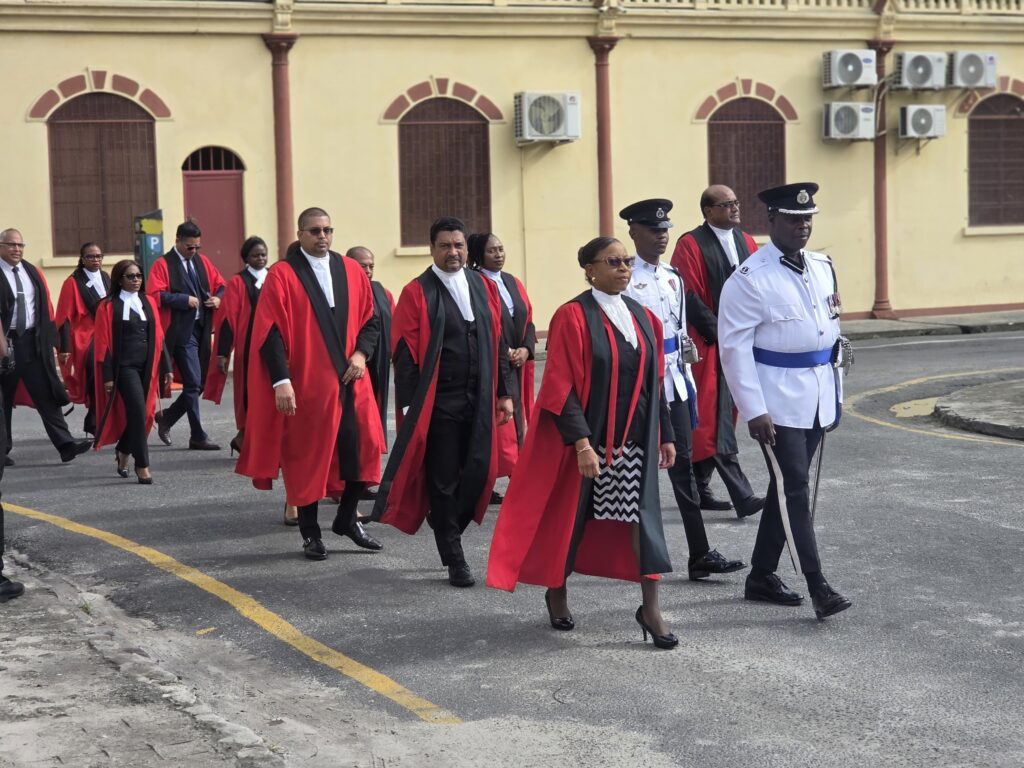
She said there are still many pending inquests, largely due to the fact that Magistrates give priority to the high volume of trial matters. In this regard, the Chancellor announced that a comprehensive review of the Magistracy will be conducted in order to determine the caseloads of Magisterial districts as well as the volume of case filings for particular types of matters. This, she said, will allow for the better management of magistrate courts.
Acting Chief Justice, Navindra Singh, in his address, underscored the importance of maintaining the Rule of Law – the foundation of a civilized society.
“The Rule of Law is not maintained by rhetoric but by conduct. It is upheld when investigations are lawful and professional, when charges are brought responsibly, when cases are prosecuted fairly and defended fearlessly, when trails are conducted efficiently and impartially, and when sentences and rulings are imposed with justice, proportionality and most importantly, in a timely manner, in accordance with the law,” the acting Chief Justice said.
Noting that the Judiciary is cognizant of the need to improve on the timely delivery of judgments, the acting Chief Justice said while backlogs exist, there has been marked improvement. However, he said, with the assistance of the Bar, there could be even greater improvement.
“Delay remains one of the most corrosive threats to public confidence, thankfully that is less present now, especially in the criminal courts. It continues to be present in the civil courts to some extent but not in any epidemic way,” he said.
While acknowledging the challenges that remain, including increased caseloads, complex investigation and limited resources, the acting Chief Justice said delays cannot be accepted as “inevitable.”
“In this Law Year, I expect renewed emphasis on active case management at all levels, and you will see it. We promise you that. Criminal and civil cases must be prepared properly, scheduled realistically and progress purposefully. Adjournments must be granted only for good cause and witness attendance must be managed firmly, and where statutory guidelines exist, they must be respected,” he said.
Guyana currently has a single Court of Appeal with two courtrooms; three High Courts – one in each county with 18 courtrooms; five Land Court rooms; and 55 Magistrates’ Courts in the 11 Magisterial Districts.
Additionally, three Magistrates’ Courts are currently under construction.
Related posts:
 Acting Chancellor Yonette Cummings returns to work
 President makes temporary appointments of Justice George as Acting Chancellor and Justice Singh as Acting Chief Justice
 Acting Chancellor and Acting Chief Justice hail CCJ for advancing jurisprudence, as Court holds sitting in Guyana
 New Acting Chancellor and Acting Chief Justice sworn into office

You must be logged in to post a comment Login