









With the El Nino weather phenomenon expected to continue in Guyana into the new year, farmers are being encouraged to make themselves fully prepared, as the long dry spell could take a toll on the country’s water resources.
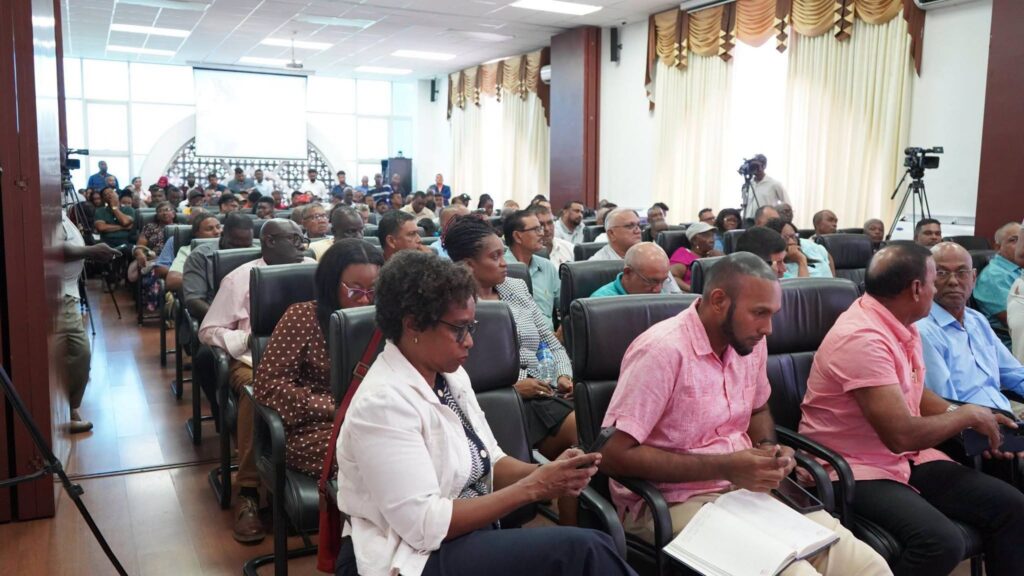
Addressing farmers and other stakeholders at an El Nino Stakeholders Preparedness Forum at the Arthur Chung Conference Centre today, the Agriculture Minister said the weather phenomenon is already affecting the availability of water, agriculture production, and food prices.
With the Hydromet Office predicting that the weather pattern will persist throughout the remaining of 2026, with a strong possibility of it continuing into the first quarter of 2027, the Agriculture Minister said it is important for farmers to get prepared by building resilience.
“Presently, we are already seeing reduced rainfall and higher temperatures in different parts of the country, so we have to take this situation seriously. But I want to make one point very clear, we are here today not to create panic, we are here to prepare,” Minister Zulfikar said.
Noting that the Ministry of Agriculture, in its preparation, is not starting from scratch, the Agriculture Minister said the Government has invested significantly in the sector’s infrastructure to build the country’s resilience to withstand these conditions.
“We know what prolong dry conditions can do to agriculture but we also have to recognize that today, Guyana is better prepared. Over the years, we have seen Government invested heavily in drainage and irrigation, conservancies, pumps, canal, farm to market road, and research and agriculture services. Our technical agencies have also built greater capacity,” he explained.
It was explained that at present, high level canals have been built in Regions Five and Six. Those structures, he said will act as reservoirs.
But Minister Mustapha also admitted that investment in infrastructure alone will not suffice. He said farmers must also do their part by conserving on water.
“Our approach has to be straight forward. Store water where we have it. Manage it carefully, and make sure it reaches farmers when they need it. Sometimes, some of us, and we know, many of us here who are farmers, when we use the water and we don’t need it, we don’t care about what happen afterwards, about the other farmers who need it. This period is very, very important for us that we have to ensure that we store it properly, we manage it carefully and it reaches the farmers when they need it,” he said.
Head of the Hydro-meteorological Service within the Ministry of Agriculture, Dr Garvin Cummings said while El Nino in other parts of the world can result in increase rainfall, in Guyana, it does not mean no rainfall but a reduction in rainfall.
“The forecast is suggesting that rainfall in Guyana, all across the country, will be significantly less than what we usually record. And note, this is all across Guyana, the rainfall amounts would be less in all regions across the country,” he said.
From September to October, the country is expected to experience an increase in temperatures.
In November, parts of the country in Regions 7, 8,9 and parts of 6 are at risk of experiencing drought like conditions.
Related posts:
 Over 4500 farmers benefitting from technological support under Sustainable Agriculture Development Programme
 GWI urges water conservation as it blames El Nino and GPL for water supply woes
 Citizens urged to conserve on water as secondary dry season approaches
 Guysuco blames El Nino for 29% sugar production shortfall for first crop

You must be logged in to post a comment Login