









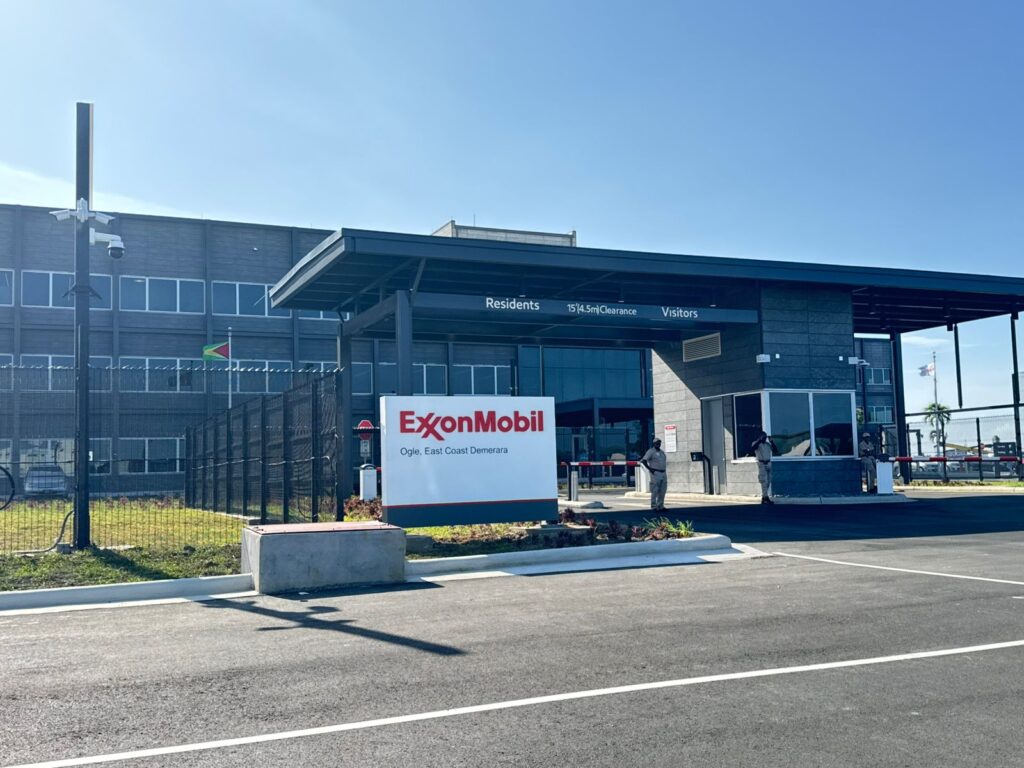
Three United States Senators are concerned that American taxpayers may be subsidizing ExxonMobil’s operation in Guyana, and are now seeking information over their concerns.
In a letter to the Chairman and Chief Executive Officer of ExxonMobil, Darren Woods, US Senators Sheldon Whitehouse, Jeffrey Merkley and Chris Van Hollen said they have taken note of ExxonMobil’s partnership with Chinese state-owned oil company – the China National Offshore Oil Corporation (CNOOC) – and HESS (now owned by Chevron) in the production of oil in the Stabroek Block in Guyana, and are concerned that the 2016 Stabroek Block Production Sharing Agreement (PSA) may have affected the company’s US Federal Tax liability.
The Senators said they are concerned about the possibility that American taxpayers may be subsidizing ExxonMobil’s foreign oil production, which they do in partnership with a Chinese state owned company.
It was pointed out that under US laws and regulations, ExxonMobil is considered a “dual capacity” taxpayer due to the fact that it is a multinational company that pays an income tax to a foreign country while also receiving a specific economic benefit from that foreign country, such as the right to extract oil and gas.
However, under the Stabroek Block PSA, the oil giant pockets 75% of the value of the oil produced and sold in cost recovery, while the remaining 25% of production is split between ExxonMobil and its partners, and the Government of Guyana.
However, the Senators pointed out that under the Production Sharing Agreement, the Government pays ExxonMobil’s Guyana income taxes out of the Government’s share of the oil profits.
In the current circumstance, the Senators have suggested that the rules prohibiting US companies from claiming foreign tax credits (FTCs) to lower their US tax bill for payments that amount to subsidies from foreign government should apply.
“ExxonMobil may not be entitled to shrink its US tax bill through any FTCs for payments made by the Government of Guyana for its taxes,” the Senators said, while adding that “payments to a foreign government in exchange for an economic benefit are not considered taxes at all, and thus cannot quality for a U.S foreign tax credit (FTC).”
They acknowledged, however, that special rules allow “dual capacity” taxpayers to divide up such payments into creditable taxes and non-creditable payments.
“While it is not difficult to distinguish between taxes and payments for economic benefits, current rules allow contracts to be structured in a way that blurs the distinction. This loophole is a particular boon to big multinational oil companies,” the Senators reasoned.
They argued that closing the loophole would save U.S taxpayers an estimated US$71.5 Billion over ten years.
“Big companies like ExxonMobil do not need any more government subsidies,” the Senators said while citing the 2021 IMF report, which stated that US subsidies to the fossil fuel industry are over $600 billion annually.
The Senators said “Republicans added even more with their ‘One Big Beautiful Bill Act,’ which included a $167 Billion handout to companies like ExxonMobil that ship jobs and profits overseas, as well as a special $427 Million carve out for the oil and gas industry to limit or avoid the Corporate Alternative Minimum Tax that is intended to prevent companies from erasing their tax bill with special breaks.”
In putting forward a total of seven questions, the Senators said they would like to better understand whether US tax dollars are subsidizing partnership with China to drill for oil overseas.
The Senators want to know if ExxonMobil provided income tax returns to the Government and if so, for which years. They also want to know if ExxonMobil claimed any US Foreign Tax Credits on any payments to the Government of Guyana in 2024 and or 2023, and whether the PSA makes a distinction between taxes owed to the Government, and payments for economic benefits.
The Senators also want to know ExxonMobil’s rationale for including the Chinese company, CNOOC, as a partner in its 2016 PSA with the Government of Guyana.
Related posts:
 Exxon remains committed to long term partnership in Guyana – ExxonMobil Guyana President
 Group of US Senators ask for “credible international observers” to be allowed to observe Guyana vote recount
 Guyana set to receive 50% of profits and 2% royalties in ExxonMobil deal
 Bank of Guyana warns money transfer service about its foreign currency dealings

You must be logged in to post a comment Login