









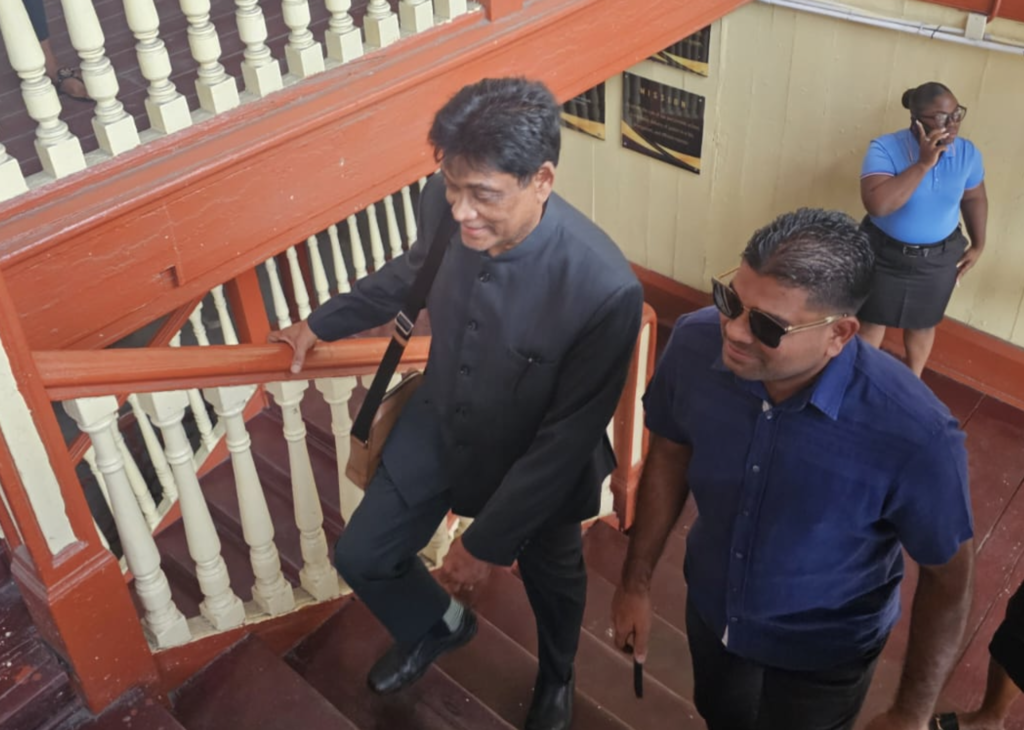
Businessmen, Nazar and Azruddin Mohamed were at Court early this morning for the continuation of their extradition case before Principal Magistrate Judy Latchman.
At this morning’s hearing, the Attorneys for the Mohameds rejected a proposal by the Prosecution for the committal proceedings to be done now by paper committal, and not via Preliminary Inquiry (PI).
The proposal was initially made by Attorney-at-Law Glen Hanoman and later backed by the lead Prosecutor, Jamaican Attorney-at-Law Terrence Williams.
It comes four months after the extradition hearing commenced in the Georgetown Magistrates’ Court before Principal Magistrate Judy Latchman, and more than a month after the first witness was called as the committal proceedings got under way.
In the Court today, Prosecutor Williams pointed to the fact Criminal Law Procedure (Paper Committal) Act 2024 abolished oral Preliminary Inquiries in favor of “paper committal,” and in doing so, sought to apply the legislation to the extradition proceedings, currently being heard in accordance with the Fugitive Offenders Act.
“The old oral preliminary inquiry has been abolished and has been replaced with preliminary inquiry on paper and as such, it would seem that the proceedings which ought to follow should be on paper,” Williams submitted to the Court.
But Magistrate Latchman questioned Williams on the nexus between the Criminal Law Procedure (Paper Committal) Act and the Extradition Case, pointing out that the defendants would have to be charged with a criminal offence.
“What would be the criminal offence in this matter? That’s one…and paper committal applies where there is a criminal offence. When a magistrate conducts a paper committal, there is absolutely no cross-examination. Cross-examination takes place in the High Court before a judge and a jury once you are committed. But isn’t the path to justice lined with examination in chief and cross-examination and re-examination? Isn’t the path to justice lined,” Magistrate Latchman questioned.
Williams, in response, told the Court that in extradition proceedings, the testing of evidence lies with the requesting state. But as he was further pressed for answers by the Magistrate, he admitted that the evidence could also be tested by the requested state, which would be Guyana in the current case. However, he further submitted that cross-examination is not necessarily the path to be taken.
But Defense Attorney, Siand Dhurjon objected to the proposal. He submitted to the Court that the Fugitive Offenders Act does not cater for the extradition proceedings to be done by way of paper committal – a position he maintained outside the Courtroom.
He said the Prosecution is now attempting to change the course of the proceedings.
“They are asking the Magistrate not to take any further oral evidence but just to admit all of the documents and decide whether or not to extradite the defendants without any question being asked from a single witness. This is indisputable evidence that the prosecution is scattered now. They are trying to abort our efforts at cross-examination, they are trying to cancel the cross-examination process because they see where it is going, they see what we are unearthing, what is being revealed, and they probably well know what will be revealed soon, and so, they are asking the Magistrate to stop taking oral evidence,” Dhurjon told reporters.
He said the Prosecution’s arguments, in support of paper committal, are deeply flawed, contending further that it would be an error of law for the Magistrate to allow the proceedings to be done via paper committal.
“The Fugitive Offenders Act, which is the Act that sets out how the extradition process ought to unfold, in minuscule detail, it sets out that there ought to be a preliminary inquiry. This is a term of art, a PI is a common law process developed hundreds of years ago and there must be cross-examination, there must be what you call viva voce or oral evidence under the Preliminary Inquiry process,” he said.
Senior Counsel Roysdale Forde, who is among the attorneys representing the Mohameds, said the Fugitive Offenders Act is clear.
“There is no basis in law at this stage for the court to even apply the paper committal. They are two different regimes two different processes would have been enacted in the two different acts. In relation to Criminal Law Offences Act, which basically deals with indictable offences it contemplates ultimately a trial in the High Court in the local country, which is Guyana. In relation to the Fugitive Offenders Act, it contemplates a preliminary enquiry and if a case is made out for extradition abroad,” he explained.
He said the application of paper committal in an extradition case would deprive the accused persons of the right to interrogate the evidence via cross-examination.
The Court has asked the Prosecution to submit their arguments on the matter in writing no later than February 26.
Meanwhile, the Court heard that Nazar Mohamed was still unwell though he was present in Court today. His Attorney explained that his presence was as a result of an “extraordinary” effort on his part. Dhurjon indicated that the elderly businessman was unable to secure an updated medical report in time for today’s hearing, and as such he opted to be present, but remains in a great deal of pain.
Asked how he was feeling by the Magistrate, Mr. Mohamed said he was still experiencing tightness in his chest, breathing difficulties, cramps in both his legs and arms and high blood pressure. It was explained that his cardiologist is currently on leave, and attempts would be made to see another doctor soon.
Mr. Mohamed addressed the Court even as his longtime associate, attorney-at-law Charrandass Persaud joined the Defense team at the lawyers’ table. However, outside the Court, Mr. Persaud who is the former High Commissioner to India and who voted against his own Government in a no-confidence motion, clarified that he is not part of the legal team, but has been paying keen attention to the case.
The case has been adjourned to February 26, 2026 at 9am.
Related posts:
 Paper committal hearing in gas station bombing case set to begin in March
 Mohameds extradition case adjourned to February 5; Magistrate warns Prosecution against further disclosures
 Prosecution and Defence tussle over disclosures in Mohameds extradition hearing; Case resumes on Friday
 Attorneys for US Government present key documents to Court in Mohameds extradition case

You must be logged in to post a comment Login