









Judges, lawyers, and other officers within the legal fraternity weighed in on the effects of social media and related technologies on children in Guyana, even as Attorney General, Anil Nandlall, assured that as the Government moves to craft a framework to regulate the use of social media with a focus on children, it does not intend to have state agencies invade the homes of families.
The Government is conducting consultations on the issue.
The Attorney General met with members of the judiciary and legal fraternity today at the Cara Lodge, and it was explained that while the use of the internet facilitates learning, research and innovation, it is important to regulate the use of social media and related technologies to protect children from the harmful effects.
The Attorney General said buy-in and support from parents and guardians would be critical as the Government moves to safeguard the country’s children.
“Why consultation? Because they are children – the Government or state agencies cannot go into your homes. Children is still in the guardianship and ward of the parents, obviously, the majority of circumstances, and therefore we need partnership with our parents, we need partnership with our teachers, we need partnership with our guardians, and we need partnership with all those who stand in some type of relationship with our children to help us to achieve this objective of regulating our children,” the Attorney General said.
Mr. Nandlall said the intention is to regulate children’s use and access to the internet, and protect them from the “dark side” of the web.
“If we allow our children to get hooked in the manner that some of them are to the computer, to the phone, then the physical side of the revolution is the deprived…We grew up physically, we grew up running barefoot in the pastures, in the fields, and played cricket or bat and ball, swam in trenches. We went into the back dam, we picked cane, climbed trees; children now don’t get those opportunities, those opportunities are not available to them,” he said.
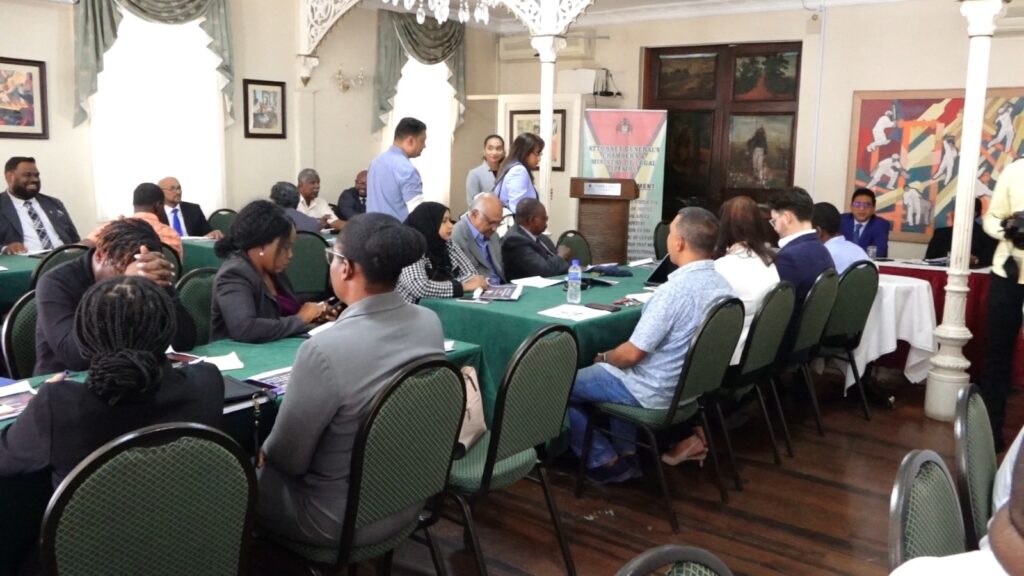
The Attorney General said there needs to be a balance in raising a child, offering his belief that children do not engage in enough physical activities.
Acting Chief Justice, Navindra Singh, who was among members of the judiciary present, said between 12-years-old and 17-years-old, the brain develops socio-emotion systems.
“The child at that time looks for reward, and that’s particularly one of the problems with social media, and they are more susceptible to stress and peer pressure. And so, it is more than likely that a child between 12 and 17 will take risks, and that is what social media does a lot. It pushes these children to do nonsense. So, I would suggest that the minimum social media age be 18,” the Chief Justice (ag) submitted.
Calling for more definitive measures, Justice Singh said social media is broken up into a number of categories, and children under the age of 18 should not have access to certain categories like social networking media or media sharing platforms like TikTok.
Former Acting Chancellor of the Judiciary, retired Justice Carl Singh, in adding his voice to the issue, spoke of the need for heightened education and awareness.
“One of the things I believe that is important, which we can’t legislate on but I would respectfully urge is an aggressive education and awareness programme for parents because much is expected of parents in terms of parental control. And there is much to be gained from an aggressive awareness programme,” Justice Singh said.
Deputy Chief Parliamentary Counsel, Joann Bond, said while digital technology supports learning, creativity, social connection, and access to information, it also exposes children to risks.
Bond said globally, there are numerous concerns including those relating to the mental health of children, the impact on cognitive development, impaired interpersonal skills, cyber bullying, and harassment, online exploitation and grooming, exposure to harmful content, and addictive platform design.
Bond said as Guyana moves to craft a legal framework, it is examining steps taken by Australia, China, the United Kingdom, France and Brazil to exam best practices and what worked.
The Government has hired a law firm from the UK to assist with the process.
Related posts:
 Government begin consultations on regulations to protect children from ills of internet and social media
 VP Jagdeo says Government has no plan to regulate free speech or clamp down on social media influencers
 AG Nandlall to introduce Cybercrime regulations to cover social media
 Attorney General clarifies that vacancy only exists for Chancellor’s post

You must be logged in to post a comment Login