








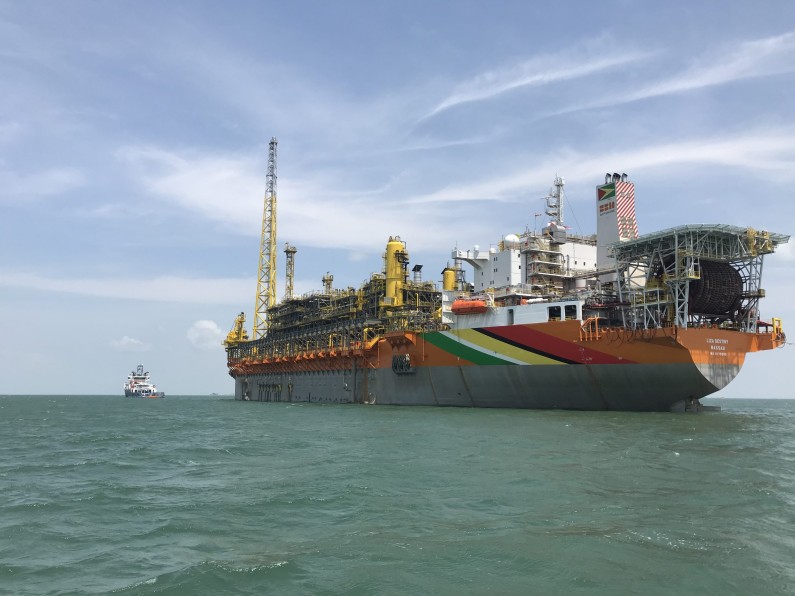
Though it has been building its capacity in the Oil and Gas Sector, the Office of the Auditor General still lacks the capacity to audit offshore activities in the Stabroek Block as oil production continues to rise.
The Auditor General’s Office has instead been redirecting its focus to agencies like the Guyana Revenue Authority (GRA), the Environmental Protection Agency (EPA) and the Guyana Geology and Mines Commission (GGMC) that are responsible for monitoring the production of oil and gas, and the revenues received.
Auditor General, Deodat Sharma, admitted to reporters on Thursday that his Office lacks the expertise and human resources necessary to audit offshore activities, noting that tremendous human resources are needed from petroleum engineers to legal experts. He said the Audit Office is nowhere close to achieving that level of capacity.
“The actual auditing in terms of the Oil and Gas Sector, I cannot audit what is happening out there. It would involve legal people, many, many engineers. No I can’t do that. So, what I will do, I will audit the Sectors that are responsible to monitor what is happening out there, like the Guyana Revenue Authority, at presently I am auditing that,” the Auditor General said.
U.S oil giant, ExxonMobil, is currently producing approximately 650,000 barrels of oil per day from the Stabroek Block. However, with the recent startup of a fourth Floating Production Storage and Offloading (FPSO) vessel – One Guyana – the company anticipates growing production to more than 900,000 barrels of oil per day by the end of the year.
In 2024, ExxonMobil recorded $1.255 Trillion in operating profit before tax.
The figure represents a 66.75% increase in profit before tax when compared to the $752.7 Billion made in 2023. Its net income stood at $995.1 Billion at the end of 2024. Guyana, on the other hand, received US$2.6B in oil revenues and royalties in 2024.
Despite a ramping up of production, the first audit of expenses declared by ExxonMobil and its co-venturers for the period 1999 to 2017, which was conducted by IHS Markit, has not been finalized with US$214M in cost recovery still in dispute.
The second audit, which examined the costs incurred between 2018 and 2022, reviewed US$7.2 Billion in declared expenses, however, US$65.1 Million remains in dispute. As of June, the third audit covering the period 2021 to 2023 was being reviewed by the Guyana Revenue Authority (GRA).
The Auditor General said he is still to receive copies of the three audits conducted to date.
“Unfortunately, I have not seen any of those reports to date. So, I am still awaiting the final report,” he said.
But Mr. Sharma said he is hopeful that in the future, the Audit Office would have the capacity to conduct the audits.

In the interim, Auditor General Sharma said the Audit Office is building capacity in the Oil and Gas Sector. He said a request for a total of nine staff for the Oil and Gas Department was declined by the Public Accounts Committee (PAC).
“In terms of the oil and gas sector, we only have about three or four staff presently. As I said, I have to get this approved by the Public Accounts Committee. I think the last Public Accounts Committee understands what I need now, although it was rejected. It was about eight or nine members that I wanted in that section. So, that will go to the new Public Accounts Committee,” Sharma said.
Together with Members of Parliament, officers of the Audit Office underwent training on auditing the Extractive Industries, in particular the Oil and Gas Sector.
The training was facilitated by the Canadian Audit and Accountability Foundation (CAAF) with support from officers from two SAI’s from AFROSAI-E that is, Uganda and Rwanda – members of the Working Group on Audit of Extractive Industries (WEGI).
On the conclusion of that training, Guyana was accepted into WEGI membership.
Additionally, through CAAF, two officers from the Audit Office attended the “Introduction to Environmental Auditing” at the International Centre for Environmental Audit and Sustainable Development. Additionally, three officers attended Crude Training, which was facilitated by the Natural Resources focusing on Marketing Terminology and Sovereign Hedging Programmes.



You must be logged in to post a comment Login