









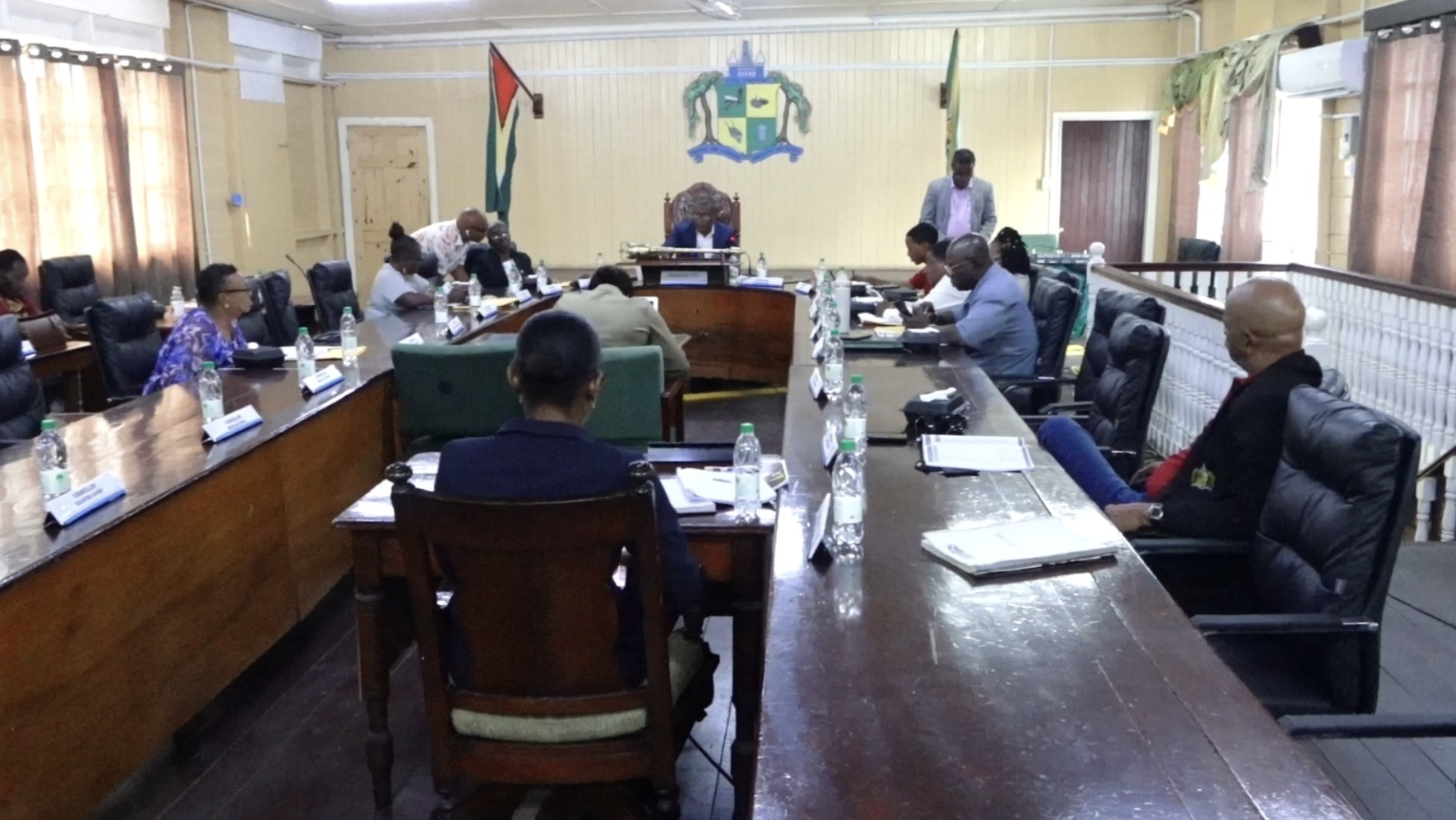
A $5.6 billion budget was presented to the Georgetown Mayor and City Council today in the absence of the People’s Progressive Party/Civic (PPP/C) Councillors, who all boycotted today’s budget presentation.
Presented by the Chairman of the Finance Committee, Lelon Saul, under the theme “Fortifying Local Foundations: Efficiency, Advocacy and Controlled Delivery amid Constraints,” the multi-billion budget is $1.2 billion more than the Council’s projected revenue for 2026, and comes even as the Council experienced significant shortfall in revenue in 2025.
But despite the projected budget deficit of $2.1 billion, an optimistic Saul told the Council not to be discouraged, assuring Councillors that to eliminate the deficit, the Council will ramp up its rate collection campaign.
“A net budget deficit of $1,285,301,701 has been identified for the period. This figure represents the core budget position and is calculated independently of the outstanding accounts receivable and accounts payable which are tracked and managed through separate processes. To eliminate this deficit, the Council will prioritize and intensify efforts to collect outstanding amounts from delinquent rate payers and other revenue streams,” the Chairman of the Finance Committee said.
It is estimated that the Municipality is owed approximately $150 Billion in rates and taxes, with $42 billion accounting for residential taxes.
Based on the budget presented, the City Treasurer is expected to rake in more than $3 billion in revenue, while the Solid Waste Department is expected to receive approximately $737 million.
Saul said the budget aims to maximize efficiency, guarantee value for money, and highlight how central government’s actions impact the council’s ability to carry out its duties.
Amid accusations from Government that it is not fulfilling its functions and responsibilities, the Council is expected to maintain 645 miles of drainage network and provide more than 34,000 properties with waste collection services.
But Saul acknowledged that the road ahead is a difficult one, particularly in wake of increasing pressures from Government, and the lack of adequate financial support.
He said in 2025, the Mayor and City Council faced an impossible mandate to govern a city of more than 225,000 residents across 40 square kilometres with a revenue stream that had effectively collapsed.
“While public blame is often misdirected at the Council for failed roads, blocked drains, and uncollected waste, the root causes are structural, legal, and deeply political. The M&CC’s inability to perform is not a failure of effort but a predictable outcome of fiscal starvation, central government overreach, a defunct Local Government Commission (LGC), and the systematic erosion of participatory democracy,” Saul said.
He submitted that antiquated laws and billions in outstanding taxes continue to fuel fiscal crisis the council now faces.
It was explained that the Council’s primary revenue source remains the general rates—a tax on property values. In 2025, the budgeted income from this stream was $2.6 billion, however, just over $1.1 billion was collected.
The figure represents a shortfall of nearly 58%.
Overall, it was projected that the council would have generated $3.8 billion in revenue, however, it was only able to rake in $1.9 billion.
Saul laid the blame at the feet of the Government, its failure to facilitate a comprehensive valuation of properties, and property owners who fail to pay their property taxes.
“The deeper pathology lies in two factors. The Valuation for Rating Purposes Act (Chapter 28:04). This Act mandates that rates be based on property valuations. The last comprehensive valuation was conducted in 1997—nearly three decades ago. Property values, land use, and economic realities have transformed entirely, yet the M&CC is legally bound to an archaic base. Consequently, rate-able values bear no relation to current market values, crippling potential revenue. Insolvent Ratepayers: Many property owners—majority residential—face a perverse reality: their accumulated debt to the Council (including penalties) now exceeds the value of their property under the 1997 valuation. Faced with impossible liabilities, they simply refuse to pay. This is not mere delinquency; it is rational economic behaviour under a broken system,” Saul explained.
He said while the Municipality continues to be starved of resources, Central Government routinely executes the functions of the Council, repairing roads and drains without notice, consultation or coordination.
Saul said while such intervention might be welcomed in an emergency, the complete absence of joint planning is an affront to good governance.
He said Central government’s intervention is often accompanied by gaslighting and public maligning of APNU councillors.
Saul made a case for the Council’s subvention to be increased, noting that the $50 million annual subvention from the Government is simply inadequate.
Related posts:
 City Council announces $4.2B Budget; Seeks more than $387 Billion in outstanding rates and taxes
 City Mayor prepared to defend waiving of interest for outstanding rates and taxes owed by city residents
 Jagdeo says “no” to City Council’s plan to re-evaluate properties for adjustments of rates and taxes
 City Businesses owe City Hall over $16.2 Billion in rates and taxes; Chamber asks them to pay up

You must be logged in to post a comment Login