









Under the theme “Navigating the Future: Guyana, The Caribbean and Latin America in a Changing Global Environment”, the Centre for International and Border Studies Conference opened this morning with regional leaders, and academia taking stock of current global challenges and their impact on the Latin America and Caribbean Region.
Assistant Secretary General of the Caribbean Community (CARICOM), Elizabeth Solomon, told the conference that from climate change to the accelerating geopolitical conflicts, global challenges are testing the principles of international law that shields small states.
“Our hemisphere is navigating geopolitical shifts deeply interconnected with conflicts far afield such as those in the Middle East and in Eastern Europe even as we navigate significant policy shifts in this hemisphere. These resulting upheavals range from supply chain disruptions to energy market fluctuations – they test the principles of international law that serves as the primary shield for small states,” the Assistant Secretary General said.
Ms. Solomon explained that to navigate the current environment, CARICOM has embarked on a deliberate strategy of diversifying external relations that are anchored in the principles of South-South Cooperation.
“We are witnessing a historic deepening of ties with the African Union, and individual African States as evidenced by our Memorandum of Understanding with the African Union. The CARICOM-AU Summit, last year, has contributed to burgeoning cooperation in health and business and in greater collaboration in pursuing reparatory justice,” she said.
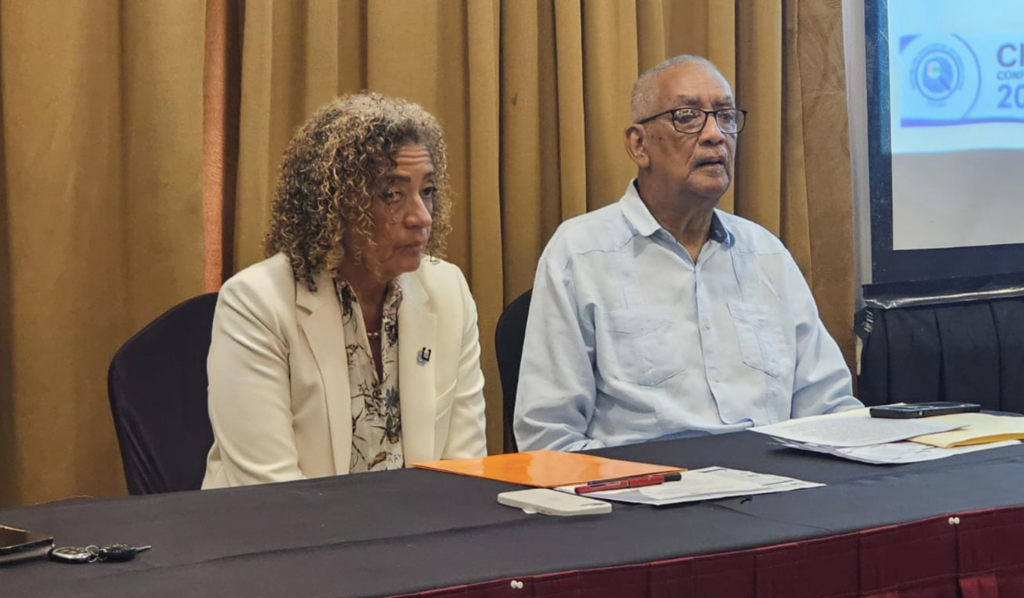
Additionally, she said the pursuit of enhanced relations across Asia and the Middle East demonstrates a community that is proactively broadening its global foot print, and seeking mutually beneficial partnerships beyond its traditional spheres of cooperation.
The Regional bloc’s relationship with its continental neighbours in Latin America and the Caribbean remains paramount, the CARICOM official noted, while adding that as small and low lying coastal developing states, engagements with them are essential for trade, regional security and the development of sustainable energy and transport corridors.
Director of the Centre for International and Border Studies, Dr Mark Kirton, in his address, said the conference represents the results of a range of multi-disciplinary research outputs. He said will cover a range of areas such as regional geopolitics, the US policy in the region, energy and food security, citizen security and migration.
Dr. Kirton said the conference takes place at a time when the global order is significantly challenged.
“In our region, the Caribbean, we see increasing levels of fragmentation in the integration process, we note the security and governance crisis in Haiti, we are observing the humanitarian crisis in Cuba, with food and electricity shortages and economies, especially in the small island developing states of the region, are under severe strain s economies contract, crime and deviant behavior increase and new forms of extractivism emerge, creating wider gaps in the quality of life for the region’s populace,” Dr. Kirton said.
He said the two-day conference will provide “bold insights” into developments both regional and globally, and will stimulate discussions on the way forward.
Established two years ago, the Centre for International and Business Studies intends to build cross-border networks, conduct multi-disciplinary research and use the research to put forward recommendations to policy makers and other stakeholders.
Since its establishment, the Centre has held discussions on the Guyana-Venezuela Border Controversy across the country, and in Brazil and Trinidad and Tobago.
Related posts:
 CARICOM Secretary General calls on member states to remain united as global environment changes
 Guyana lands support of Latin America and Caribbean States for non-permanent seat on UN Security Council
 Guyana outpacing rest of Caribbean and Latin America in economic growth -World Bank report
 Arms Trade Consultation examines gun violence in Guyana and Caribbean

You must be logged in to post a comment Login