









Essequibo was never administered by Spain or Venezuela, Guyana’s Agent Carl Greenidge told the International Court of Justice, as he presented the Court with the historical facts in the 1899 Arbitral Award Case (Guyana v. Venezuela).
Addressing a panel of Judges in The Hague, led by President of the International Court of Justice (ICJ), Justice Iwasawa Yuji, Mr. Greenidge told the Court that historical records show that Essequibo was first administered by the Dutch and later Great Britain.
“In sharp contrast to the widespread Dutch settlement of the territory lying between the Essequibo and Orinoco Rivers, there were no Spanish settlements east of the Orinoco. Venezuela recognizes Dutch presence on the West Bank of the Essequibo but seeks to characterize this as very limited and temporary in nature – that is historically inaccurate and not supported by the evidence. What Venezuela does not say and what it cannot say is that there was any Spanish settlement or administration in this territory,” Greenidge argued.
He told the Court that it was during the 19th century that the Dutch were displaced by Great Britain, and not by Spain or Venezuela. Berbice, Demerara and Essequibo were later merged together to form the Colony of British Guiana.
The Court heard that prior to 1897, the boundary between British Guiana and Venezuela had not been formally agreed. However, the 1899 Arbitral Award, which was accepted by both sides, clearly established the boundaries.
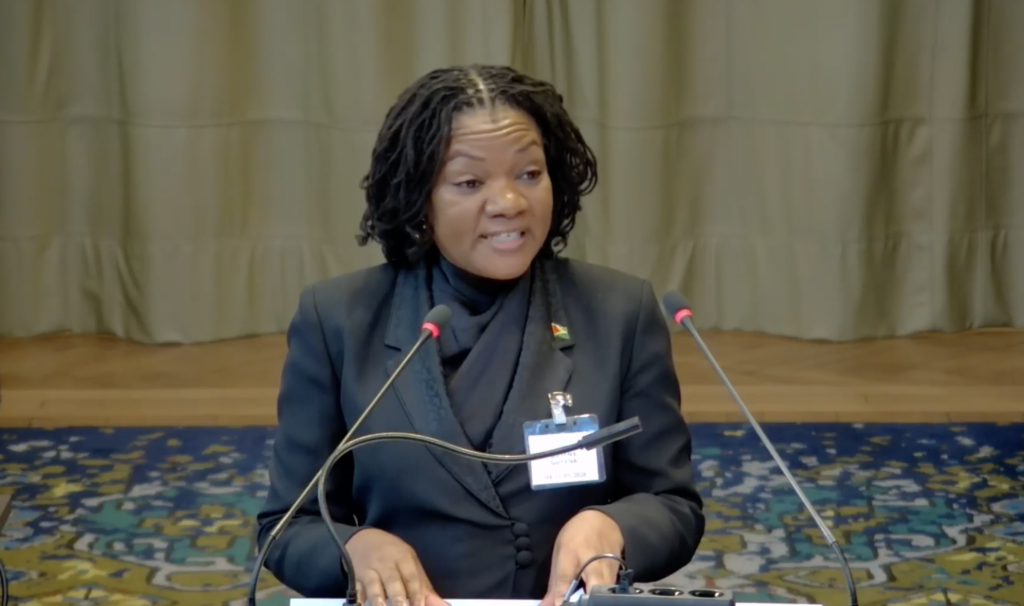
Adding her voice in defence of Guyana, Ambassador and Director of the Frontiers Division at the Ministry of Foreign Affairs and International Cooperation Donnette Streete spoke of the grave implications of Venezuela’s unfounded claims to more than 70% of Guyana’s territory.
Addressing the panel of judges, Ambassador Streete told the Court that Venezuela’s claim is not directed to some remote frontier but rather directed at the heart of Guyana.
It was explained that the area claimed by Venezuela comprises all of Guyana’s land territory lying to the west of the Essequibo River, and includes six of the country’s 10 Administrative Regions.
“Venezuela is claiming almost three-quarters of Guyana’s sovereign territory and in which much of Guyana’s population lives, where much of its economic activities take place, and where its most precious natural ecological and cultural treasures are found. For a small developing nation, the loss of almost three-quarters of its territory would not be a border adjustment, it would be dismemberment. Indeed, the effective destruction of the country,” Ambassador Streete warned.
Ambassador Streete submitted to the Court that the ecological significance of the Essequibo Region is matched by its economic importance.
“The region is the engine of our economic development. Gold mining in parts of the region dates back to the 19th century. Considerable deposits of bauxite and manganese are also found in the Essequibo Region. There are significant potential for the exploitation of oil and natural gas in the waters adjacent to its coast. These natural endowments are essential to Guyana’s economic development. The region also supports substantial agricultural activities from rice cultivation, along the low-lying coastal areas to cattle ranching in the Upper Essequibo area which supplies beef for export,” the Ambassador explained.
At present, there are more than 313,000 people living in the Region – accounting for one-third of the country’s population.
Noting that Essequibo is integral to Guyana, Ambassador Streete told the Court that Guyana has never laid claim to anyone else’s territory, but insists on its right to its own territory. It was on that note that she invited the ICJ to uphold the 1899 Arbitral Award, which concretize the boundaries between Guyana and Venezuela, and reject the claims made by Venezuela.
Related posts:
 Venezuela files Rejoinder in Guyana’s case at the International Court of Justice
 Greenidge tells International Court that Venezuela’s planned referendum threatens peace and security of Guyana and the Caribbean region
 Guyana asks International Court to block questions in Venezuela’s planned referendum on Essequibo controversy
 Guyana Government rejects Venezuela’s referendum seeking to make Guyana’s Essequibo a Venezuelan state; International Community alerted

You must be logged in to post a comment Login