









Legal Counsel, Paul Reichler, who is among a battery of lawyers representing Guyana in the 1899 Arbitral Award Case (Guyana v. Venezuela) told the International Court of Justice today that Venezuela’s claims, which seek to invalidate the 1897 Treaty of Washington and ultimately the 1899 Arbitral Award, are “illogical, counter-factual and baseless”.
He reminded the Court that it was Venezuela, with the backing of the United States, that had pushed for arbitration to settle the dispute of the boundaries it had shared with the then British Guiana.
More than six decades after agreeing to the October 3, 1899 Arbitral Award, Venezuela contended that the Arbitral Award was null, void and of no effect on the grounds that the 1897 Treaty of Washington, which set the foundation for the award to be issued, was also invalid.
Reichler told the Court that Venezuela “accepted, respected and complied” with the 1899 Arbitral Award for more than 60 years. It was explained that it was not until 1962 that Venezuelan formally challenged the validity of the award, and later the validity of the treaty.
Contextualizing the issue, Reichler explained that in the 1840s, a dispute over the boundaries between Venezuela and then British Guiana had intensified.
He said out of concern that Great Britain was expanding its British settlement “westward”, Venezuela pushed for the dispute to be settled by way of arbitration, and in doing so, enlisted the support of the United States.
Great Britain, at the time had “systematically” refused such a solution.
Together with the U.S, Venezuela consistently heaped pressure on Great Britain with threats of US military intervention, giving rise to the Treaty of Washington.
In 1897, the two sides signed onto the Treaty, agreeing to submit the dispute regarding the location of their land boundary to a binding arbitration before a tribunal of eminent jurists.
Reichler told the panel of judges that Venezuela’s then President, Joaquin Crespo, in April 1897 praised the Treaty, as he brushed aside contentions now that the Treaty was signed in error.
“The Venezuelan President expressed gratitude to the United States for the part it played in negotiating the treaty. It is eminently just to acknowledge that the Great Republic endeavored persistently to direct the matter by the most favorable route, and that the outcome achieved represents an effort of intelligence and will, worthy of praise and gratitude from those of us who are familiar with the intricate details of this very complicated matter. The Treaty was then ratified by the Venezuelan congress by way of a legislative decree on 17th April 1897…None of these facts, none of them are or can legitimately be disputed,” Reichler said as he quoted excerpts of the Venezuelan President’s speech at the time.
Reichler said Venezuela’s contention now that Treaty was negotiated by the United States and Great Britain behind its back, and that the two countries colluded in the interest of Great Britain, and at the expense of Venezuela, is a “hard sell.”
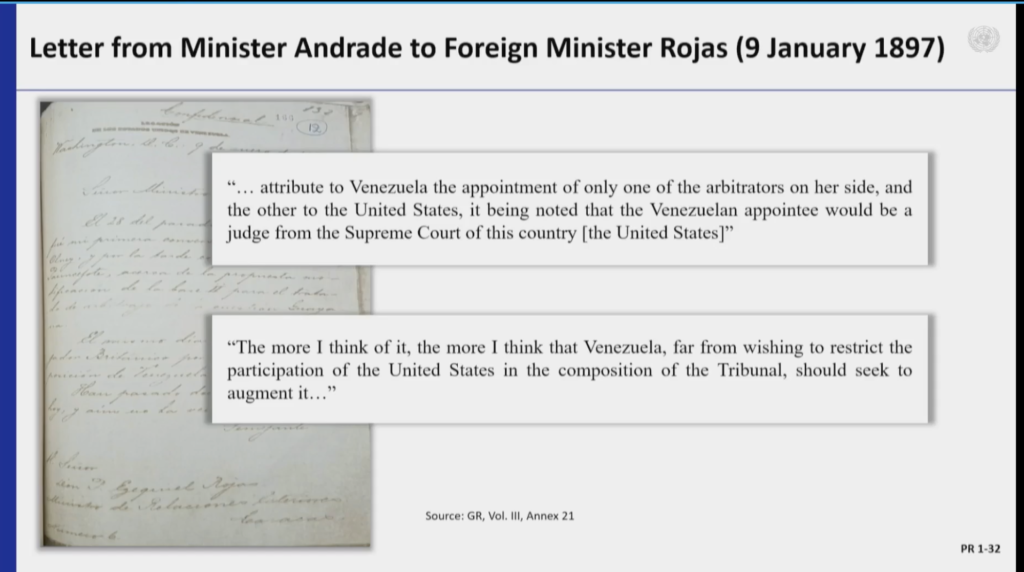
“Mr. President, neither Venezuela’s contention of fraud nor its contention of error withstands scrutiny or is even plausible. In the first place, its contentions are counterintuitive. They strain credulity, requiring you to conclude that the United States, which between 1883 and 1896 had consistently supported Venezuela in opposing British Colonial expansion and demanding that Britain accede to arbitration of the territorial dispute, made a complete volte-face when negotiation of the arbitration began by switching sides and supporting Britain’s interest in the disputed territory to the prejudice of Venezuela,” the Legal Counsel said.
He said the historic records would show that US was in full support of Venezuela, and that Venezuela had agreed to have US officials negotiate on its behalf prior to the signing of the Treaty Agreement.
Reichler submitted to the panel of judges that apart from being “illogical”, the arguments put forward by Venezuela are “completely counter-factual” and are in clear contradiction with the documentary evidence before the Court.
Under the Treaty of Washington, the two sides agreed to accept the Tribunal Award as “a full, perfect and final settlement” of the boundary issue.
On October 3, 1899, the Arbitral Tribunal delivered its unanimous Award, which determined the boundary between Venezuela and then British Guiana. Guyana today maintains that the award remains in full effect, and it has therefore asked the ICJ to uphold its validity.
Today marked the beginning and the end of the first round of oral arguments put forward by Guyana on the merits of the case brought by the English speaking South American nation against its neighbour to the west. The hearings continue on Wednesday, with arguments from Venezuela.
Related posts:
 US and UK remain supportive of Guyana’s territorial integrity and 1899 Arbitral Award
 Guyana Government observes 124th anniversary of 1899 settlement of border dispute with Venezuela
 1899 Arbitral Award establishing Guyana/Venezuela land boundary must be respected -US Asst. Secretary of State
 Guyana reiterates call for Venezuela to respect 1899 Arbitral Award on anniversary of the ruling

You must be logged in to post a comment Login