









Former President of Guyana Donald Ramotar has accused the United States of pressuring Guyana and other countries across Latin America and the Caribbean to end their medical cooperation agreements with Cuba, saying the situation has weakened Guyana’s relationship with Havana.
He said he would like to see the agreement restored.
In March, Guyana’s Minister of Health, Dr Frank Anthony, said the Government was in talks with Cuban authorities after the Government of Cuba decided to withdraw the Cuban Medical Brigade from Guyana, bringing an abrupt end to the longstanding medical cooperation arrangement between the two countries.
But in an interview on the SOURCES talk show, which will air this Sunday, former President Ramotar said he is not convinced that Cuba was responsible for the end of the medical cooperation arrangement.
“I don’t necessarily think so. This agreement was here for 50 years. It was something recognized for 50 years. Cuba was living under tremendous blockade from the United States, and one of the ways, Cuba was able to earn money was to export skills, and the whole Caribbean, and not only the Caribbean, Latin America and even further afield had a similar kind of agreement with Cuba. The United States wanted to try in every way possible to prevent Cuba from progressing, they don’t want another alternative type of Government to succeed, and I think they are the ones who have been putting pressure on all of the Governments in our region and beyond to try to isolate Cuba,” Mr. Ramotar said.
Ramotar said that the US has been pressuring countries in the region to isolate Cuba, and it would appear that Washington has achieved “some success.”
The former President suggested that Guyana may have felt compelled to respond to pressure from the US, given the support it has received from Washington amid threats from Venezuela.
“At that time you know that the Americans had come out openly to support us with the Venezuelan issue, so I think that was a factor involved in some of the pressure they were under. The Government was not getting any other opened support from any other source to say that we stand with you with Venezuela’s open threats to you. So, I think all of those things played on the Government’s mind too,” the former President said.
The former President also argued that the end of the medical cooperation agreement has affected Cuba’s resources, and its ability to export the skills of its people, notwithstanding the country’s investment in their education.
The situation, he said, has weakened the relationship between Guyana and Cuba.
“Cuba has been consciously making a big investment in their human capital. Cuba today has probably the highest literacy in the world and some of the highest skills in the world and this was what Cuba was making some of its resources on. So, I would believe it just seems to be natural that if you are going to reduce the amount of capacity of the Cubans to provide services for their own people that the relationship would not be as cordial as it used to be,” Mr. Ramotar said.
With no agreement in place, the Guyana Government has opted to hire Cuban medical personnel directly. However, the former President said he would like to see the agreement restored.
“I would like to see, I would like to see those things restored but I am not running the Government, and I don’t want to run the Government from outside of the Government,” Mr. Ramotar said.
Earlier this year, Cuba’s Ambassador to Guyana, Jorge Francisco Soberón Luis, told News Source that his country was willing to continue medical cooperation with Guyana and other Caribbean countries.
He explained, however, that in Guyana’s case, the failure to conclude a new agreement resulted in the withdrawal of the Cuban Medical Mission.
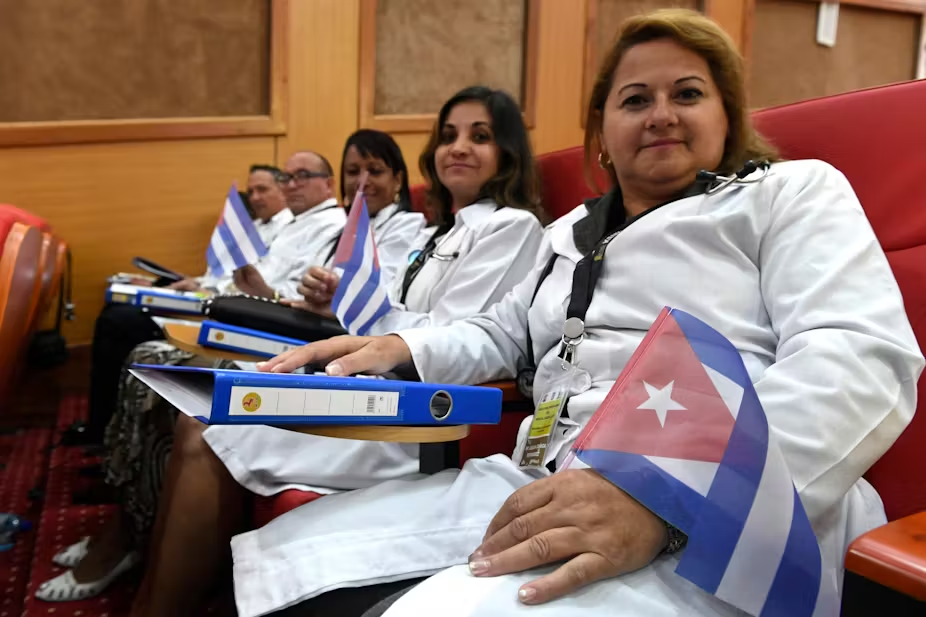
The Cuban Ambassador also explained that since 2025, the United States has been pressuring countries across Latin America and the Caribbean to end their medical cooperation arrangements with Cuba based on what he described as “unfounded claims of forced labour and human trafficking.”
The United States has publicly raised concerns about alleged forced labour and exploitation in Cuba’s overseas medical programme.
U.S. State Department reporting has cited accounts from former participants and international observers alleging restrictions on movement, withholding of wages or travel documents, surveillance and other coercive practices. Cuba has rejected accusations that its medical missions amount to human trafficking.
In 2025, the US announced visa-related measures targeting foreign officials accused of facilitating what Washington characterises as the exploitation of Cuban workers through overseas labour programmes.
The dispute over Cuba’s overseas medical programme comes amid broader pressure from Washington on Havana. That pressure has intensified following the U.S.-led removal and capture of former Venezuelan President Nicolás Maduro in January 2026.
Related posts:
 Cuba willing to continue medical cooperation with Guyana -says Cuban Ambassador
 Cuba and not Guyana ended Cuban Medical Brigade arrangement -says Health Minister
 President to return today following successful medical evaluation in Cuba
 President Granger and Cuban President hold discussions on co-operation and US/Cuba relations

You must be logged in to post a comment Login