









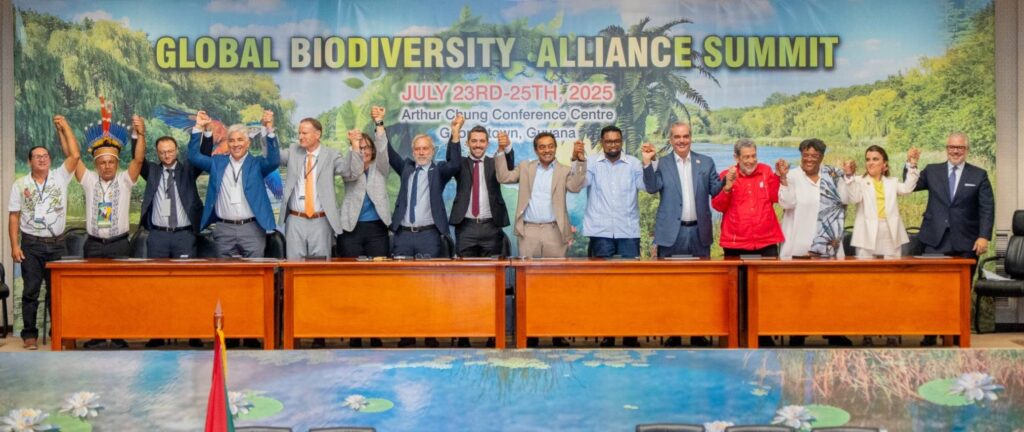
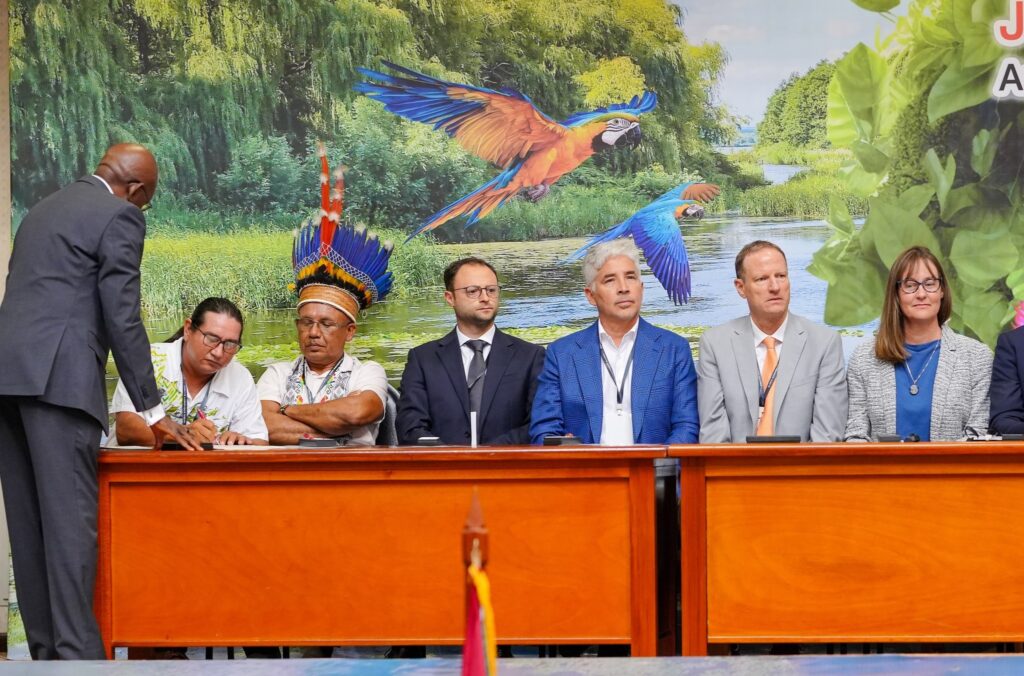
Guyana, the Dominican Republic, Barbados, St Vincent and the Grenadines and Ecuador are among the first signatories to the Global Biodiversity Alliance. The signing marked the beginning of a global movement and a call to action for countries and institutions to work together to protect the ecosystems that sustain life on earth.
President Irfaan Ali, during the launch of the Global Biodiversity Alliance at the Arthur Chung Conference Centre on Wednesday, said the Alliance is a rallying cry to governments, institutions, investors, communities and citizens to acknowledge that biodiversity is the infrastructure of life and investment in it is not a luxury but rather a necessity.
As he addressed global leaders and experts at the Summit, he said a global alliance is imperative.
“We need a Global Biodiversity Alliance because nature doesn’t recognize borders, and neither should our efforts to protect it. Nature is global, and so must our actions be. By bringing together countries, communities, scientists and leaders, we can share knowledge, pool resources and tackle major challenges such as habitat loss and climate change more swiftly and effectively. Together, we can safeguard our planet’s incredible variety of life for today and tomorrow,” President Ali said.
The Alliance will pursue five strategic pillars: advancing the 30×30 conservation goal—which aims to protect 30% of the world’s land and ocean areas by 2030; embedding biodiversity into policy and planning frameworks; unlocking innovative financing solutions; empowering Indigenous and local communities; and strengthening accountability through robust global monitoring tools.
According to President Ali, the Alliance is not merely an environmental imperative, but an economic revolution.
Accordingly, the Alliance is committed to scaling blended finance to de-risk investment in nature-based enterprises; piloting biodiversity credits that reward stewardship; expanding debt-for-nature swaps, modelled on Guyana’s experience; and supporting community-driven finance models that place Indigenous leadership at the centre.
“We invite development banks, asset managers, impact investors and sovereign wealth funds to join us, because financing nature is not charity, it is insurance. It is resilience. It is a return on investment,” the President urged.
President of the Dominican Republic, Luis Albinader in his address said as a Small Island Developing State (SIDS), the DR knows all too well the fragility of the ecosystem, as he lobbied the Alliance to find sustainable solutions to the environmental challenges confronting SIDS.
He said for its part, the Dominican Republic has committed to the Kunming-Montreal Global Biodiversity Framework – the landmark international agreement adopted at the UN Biodiversity Conference (COP15) in 2022 with the aim of halting and reversing biodiversity loss by 2030.
That framework, President Albinader explained, has been integrated into his country’s national strategy for conservation and sustainable use of biodiversity, supported by an action plan 2025-2035.
He said the Dominican Republic is moving forward with concrete actions, and has strengthened its national system of protected areas. It is estimated by 2030, the DR will reach the global goal of protecting 30% of its land and marine areas.
“At the same time, we promote the restoration of watersheds, mangrove, wetlands and coral reef, promoting local bio-economies and recognizing the real value of our natural capital. We do all this with a human centered approach, placing the most vulnerable communities at the center and betting on inclusive development. However, the challenges persist. Sargassum – sargassum is a serious threat. It affects marine life, coastal health, tourism, and artisanal fishing,” he said.
Prime Minister of Barbados, Mia Mottley said for its part, Barbados with the help of the Barbados Wetlands Trust has resuscitated the Graeme Hall Nature Sanctuary which was closed for approximately 16 years.
She also announced that the Barbados Oceans and Coastal Authority will be established by an Act of Parliament soon.
“Barbados Oceans and Coastal Authority will be established by an act of Parliament within the next few months. The draft bill having been completed is now being presented to Cabinet. And this is going to elevate the work that we must do to preserve our coastal areas, one from the erosion of sargassum, which is deadly on our eastern coast but two also, from the natural erosion that is taking place as a result of agriculture run off and other factors, which quite frankly, threatens what is our greatest concern – the stability of our water supply,” Prime Minister Mottley said.
It was explained that if the island’s aquifers are polluted by salt water, Barbados would no longer be able to use the aquifers for the provision of drinking water. She said impact of coastal erosion can be devastating on the island.
Former President of the Republic of Colombia, Ivan Duque Marquez; Conservation International, the Center for Biodiversity and Global Change at the Yale University, the Frankfurt Zoological Society, the Keller Science Action Center, Campaign for Nature, the National Toshoas Council, the South Rupununi Conservation Society, the Ecosystems and Biodiversity Bank of Latin America and Caribbean and Origination EMEA have also signed on to be part of the alliance.
Related posts:
 Global Biodiversity Summit opens in Guyana
 Former US President pledges support of Clinton Global Initiative to push for stronger Caribbean region
 Alliance For Change to contest elections in less local authority areas
 President calls for new approach for protection of Guiana Shield at Biodiversity Conference

You must be logged in to post a comment Login