









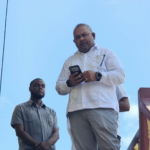
Head of the Special Branch of the Guyana Police Force, Senior Superintendent Prem Narine, returned to the witness stand this morning as extradition proceedings against businessman and Opposition Leader Azruddin Mohamed and his father, Nazar Mohamed, continued.
During his testimony, Narine told the court that he considers Azruddin Mohamed a threat to society and national security.
The statement came as Narine was questioned about the decision to arrest Mohamed days before he was due to be sworn in as a Member of Parliament, and whether that decision was politically motivated.
Mohamed, his father and their companies were sanctioned by the United States in 2024. One year later, the two men were indicted by a US grand jury on allegations of wire fraud, mail fraud and money laundering. An extradition request followed.
During cross-examination today, Narine was asked whether he was aware of statements reportedly made by President Irfaan Ali describing Mohamed as a threat to Guyana’s sovereignty.
“I am not aware of the President’s statement, but what I am aware of is that Azruddin Mohamed is a threat to society,” Narine told the court.
The Special Branch Head went further, telling the court that, based on information he had received, Mohamed is also a threat to national security.
Mohamed’s attorney, Siand Dhurjon, suggested to Narine that it was President Ali who instructed him to proceed to the Attorney General’s Chambers on October 31, 2025, to uplift a bundle of documents, including the extradition request, the authority to proceed and two draft warrants.
The attorney also suggested that Narine was instructed to ensure that the Mohameds were arrested ahead of the November 3, 2025 sitting of the National Assembly.
Narine denied the suggestions.
He told the court that he could not recall who instructed him to uplift the documents from the Attorney General’s Chambers or who instructed him to arrest the Mohameds. However, he was certain that the instructions did not come from the President.
Further questioned by Dhurjon about whether it was customary for the Attorney General’s Chambers to prepare draft warrants for the police, Narine said he was unaware.
Narine also told the court that, in his 26-year career, this was the first time he had been instructed to uplift extradition documents from the Attorney General’s Chambers. He said it was also the first time he had been involved in extradition proceedings.
Relying on the Standing Orders of the Guyana Police Force, particularly Section 50, which outlines the functions of the Special Branch, Dhurjon suggested that the unit was involved in the extradition proceedings because the matter was being treated as a political crime.
Narine rejected that suggestion.
He explained, however, that the Special Branch is prohibited from investigating and prosecuting general crimes and deals with offences under the Official Secrets Act, as well as sedition and acts of sabotage.
The extradition proceedings will continue at the Georgetown Magistrates’ Court tomorrow, when Narine is expected to return to the witness box.
Related posts:
 Special Branch Head testifies in Mohameds extradition case; Two Documents Blocked
 Azruddin Mohamed and Nazar Mohamed declare innocence of charges in US indictment
 Nazar and Azruddin Mohamed granted $150,000 bail each after arrested on extradition request
 President says political opponent, Azruddin Mohamed is a “security risk” to Guyana

You must be logged in to post a comment Login