









While Guyana is now considered one of the world’s fastest-growing economies, it continues to be plagued by institutional corruption, weak systems and a vulnerable environment, according to the Founder of Tamukke Feminist, Akola Thompson.
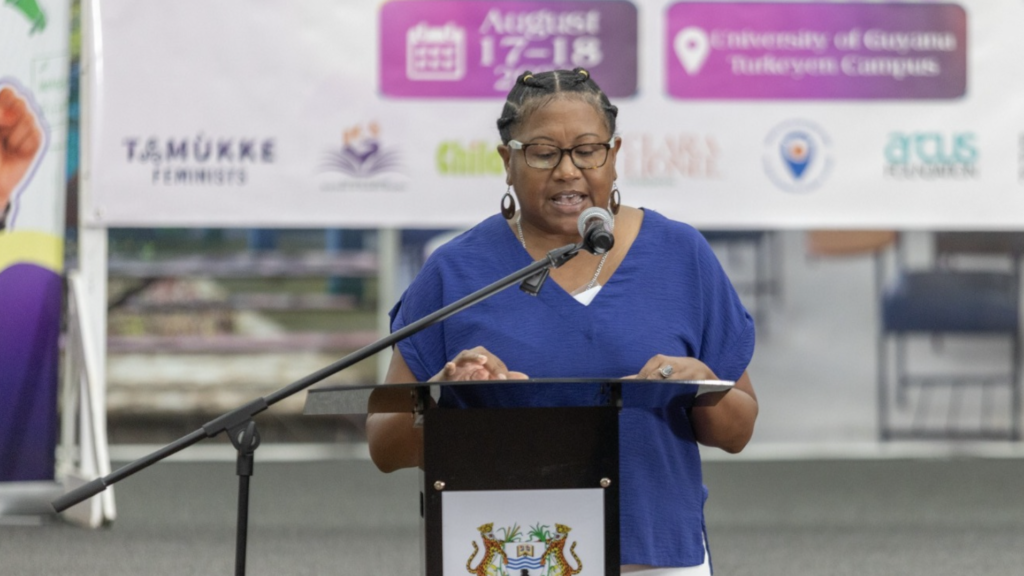
She offered the assessment this morning at the opening of the ‘Gender on the Frontlines: Roles, Risks, and Urgency in a Changing Environment Conference’ at the University of Guyana.
Thompson said in the fastest growing economy in the world, the country has found itself mourning the death of 73 persons with more than 30 others still missing following the MV Barima tragedy.
She said the tragedy was caused by institutional neglect, and represents a pattern of how easily some lives are dismissed.
“The reality is that while Guyana’s economy has come quite a long way from being regularly touted behind Haiti as the second poorest country in the Western Hemisphere, the conditions that brought about that descriptor: the neocolonial hold, institutional corruption, weak systems and vulnerable environments continue to coalesce to impact our most vulnerable groups,” Thompson told the conference.
Thompson said at the same time, climate change and the country’s expansive extractive industries continue to take a toll on vulnerable communities, with extreme weather events driving food prices up, making it difficult for the poor and vulnerable to eat.

“Guyana holds the boast of being one of the only countries able to feed itself but when last has that been a reality for many? The price for vegetables, fruits and dried goods in the past three years have risen so sharply that many families have shifted their eating habits. Many women are reporting having to ration meals weekly. In Indigenous communities, often hailed as food secure, many are facing these same challenges as their diets change due to the impacts of shifting weather patterns, and the economic drivers of extraction,” Thompsons said.
She said in the indigenous village of Parabara in Region 9, women are reportedly making the choice to either eat mercury laden fish or stop using their rivers entirely owing to suspected pollution.
In Georgetown, Thompson said, the environmental impact of expansive construction projects has disrupted living and social patterns for many, who are affected by noise pollution, and chronic respiratory illness.
Thompson said the two-day conference, which will examine how extractive industries, land, and gender justice intersect in Guyana, will provide an opportunity for academics, community leaders and artists working on the frontlines to discuss the compounding threats of climate change and its drivers.
U.S based Guyanese Environmental Engineer and Academic, Dr. Maya Trotz said the people most often described as vulnerable are not only vulnerable, but are also early warners, constant monitors, and innovators.
Trotz said it is the regular man and woman in the street, and the frontline workers who often detect environmental change before institutions do as they care for the environment.
Environmental protection, Trotz argued, cannot be separated from gender, community knowledge and everyday care, provided by those on the ground.
“They know when water smells different, when boiling or filters are needed because what comes through the tap is not potable, when black tanks and buckets are needed because water comes at a trickle or does not come at all, when children’s skin changes, when fish move, when a reef looks sick, when flooding follows a new pattern. They may not call it data, science, or infrastructure, but their care is an early warning infrastructure,” Trotz said.
Trotz said “caregivers” are keepers of environmental intelligence, and it is therefore important for policies and infrastructure to be built with people as the co-designers, co-researchers and co-leaders from the building.
The two day conference is being hosted by Tamukke Feminist in partnership with the University of Guyana.
Related posts:
 Conference examines Guyana, the Caribbean and Latin America in a Changing Global Environment
 Men on Mission to construct 50 homes for the vulnerable while introducing programmes to address gender-based violence
 UN Special Conference hears of Guyana’s strides in gender equality and women empowerment
 Major UN Conference on Land Management and Impact of Climate Change opens in Guyana

You must be logged in to post a comment Login