









The Guyana Energy Conference and Supply Chain Expo opened this morning at the Guyana Marriott Hotel with President Irfaan Ali detailing a plan that allows the country to leverage its rapidly growing Oil and Gas Sector to propel growth and development locally, regionally and even globally.
Considered the world’s fastest growing oil producer, Guyana has an estimated recoverable reserve of more than 11 Billion barrels.
In November 2025, oil production peaked at 900,000 barrels per day.
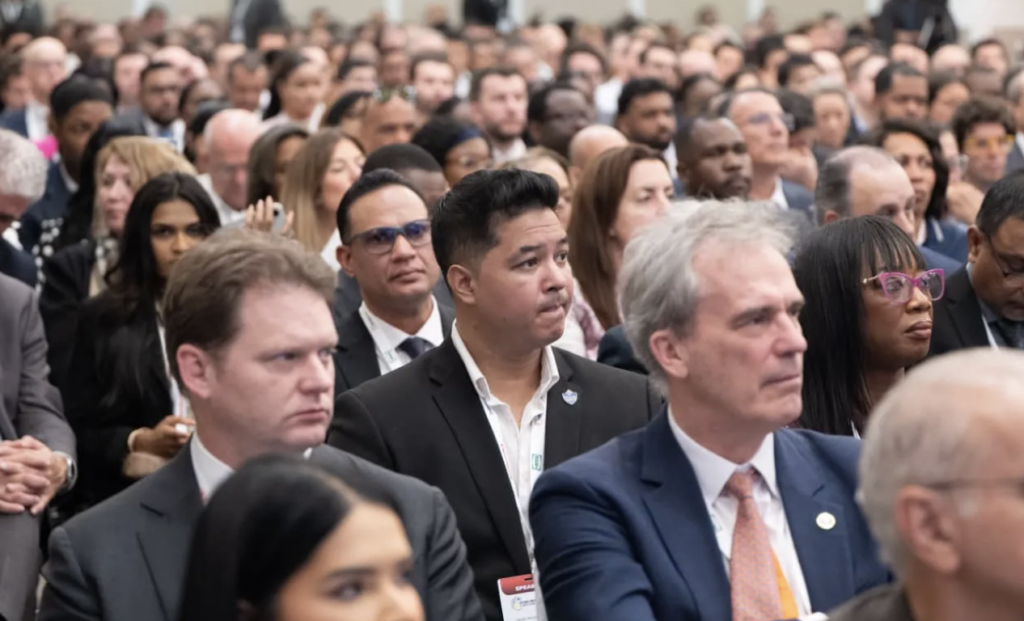
In his address to an overflowing conference hall, President Ali said to build tomorrow’s future today, Guyana must forge strategic alliances and partnerships, with a major focus on infrastructure development in the areas of transport and logistics, human resources, energy security, finance, and food security.
“It is about us building the infrastructure, creating the infrastructure, investing in the infrastructure, investing in what will optimize these long term opportunities. That is why is have Saudi Arabia here with us, and we are working with the Kingdom of Saudi Arabia, UAE, Qatar, the US, Bechtel. And we are working on what? The most transformative infrastructure for tomorrow’s future – the deepwater port,” the President said.
The President said due to Guyana’s strategic location, the deepwater port will further bridge the country with Brazil and the rest of the region, thereby transforming it into a regional transport and logistics hub.
“That by itself creates an ecosystem that generates high paying jobs, that leads to industrialization and manufacturing, and accelerate the productive sector. And here again, we are blessed with resources, we are blessed with resources that allows us to build an economy and accelerate our own productive capacity,” he said.
Turning his attention to the Energy Sector, President Ali noted that Guyana is in the process of completing its first Gas-to-Energy Power Plant, while the plan for the construction of the second power plant is being finalized. The Government has also invited Expression of Interest (EOI) for the construction of the Amaila Fall Hydropower Project.
On a regional front, however, the Government has its eyes set on exporting energy.
“We are working with our partners to leverage our gas and our petroleum to become an energy exporter in the region – exporter in terms of infrastructure and logistics. So, our national security must lead to regional energy security that allows us to be more structurally integrated in the rest of the region,” the President explained.
Additionally, with increased energy capacity, Guyana intends to ramp up its production of value-added products, which is being seen as a move that would further diversify the country’s economy and simultaneously integrate it with the rest of the global system.
“Yes, these things are not cheap, they are costly! But if we want to create an economy system that is ready for the world in relation to the standards that are needed for our products to get out there, then we have to embrace the best in class, so that our time to get to the market, our time to get to the best technology, our time to be ready is shortened, and that is why we are partnering with the best,” he said.
He said with vast arable lands and fresh water, Guyana has a responsibility to produce quality food and at good prices for the region. He said Guyana has begun that process by integrating its food ecosystem with that of Northern Brazil through technology transfer.
President Ali posited that investments in energy, manufacturing, food production, eco-tourism, aviation and other new and emerging sectors would lend to the creation of sustainable high quality jobs.
The Guyana Energy Conference and Supply Chain Expo has brought together more than 5000 persons in the energy sector and the oil and gas industry.
During the course of the four-day conference, attendees will be exploring developments and opportunities in energy and supply chain management.
Related posts:
 Conference Village opens at Kingston Esplanade ahead of Energy Conference and Supply Chain Expo
 President unveils master plan for Guyana’s development at Energy Conference; Major focus on transportation and logistics development
 China offers to further push investment and infrastructure development in Guyana
 Energy Conference hailed as key player in Guyana’s development of its oil and gas resources

You must be logged in to post a comment Login