









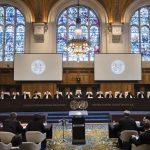
Guyana dismantled Venezuela’s “myths” underpinning its claim to the Essequibo, telling the International Court of Justice (ICJ) today that the Bolivarian Republic, in its submissions to the Court, has failed to provide “contemporaneous evidence” to support its claims and has instead opted to “misconstrue” both the 1897 Treaty of Washington and the 1966 Geneva Agreement.
In his address to the panel of judges, Guyana’s legal counsel Paul Reichler said the 1897 Treaty and the 1966 Agreement represent the beginning and the end of a mythological narrative propagated by Venezuela to depict itself as the noble and virtuous victim of British colonialism and American hegemony, which purportedly came together to rob it of its holy land.
Reichler told the Court that Venezuela would want it to believe that it was bullied, defrauded, and coerced into signing the 1899 Arbitral Award that established the land boundary between itself and then British Guiana, and for more than 60 years, it was kept in a state of ignorance and therefore could not protest the award.
“In this self-serving and fictitious narrative, the roles of victim and aggressor are reversed. Venezuela, which misconstrues both the 1897 Treaty and the 1966 Agreement and belatedly and groundlessly rejects the 1899 [Arbitral] Award, is in historical reality the aggressor, having obstructed and delayed Guyana’s independence and threatened it ever since. And more recently, in defiance of the court’s orders, having adopted legislation to annex over 70% of Guyana’s territory. Yet, it tries to portray itself as the victim of colonialism, perpetuated by the British over a century ago and perpetuated by Guyana as the beneficiary of British imperial expansion into Venezuela’s own territory. This is nothing more than a cynical inversion of history, but it underlines and explains Venezuela’s entire case,” Reichler argued.
While emphasizing that it is Venezuela that is attempting to deprive Guyana of a vast majority of its sovereign territory, Reichler told the court that all of the myths peddled by Venezuela were unraveled when confronted with contemporaneous documentary evidence.
“We presented that evidence methodically, comprehensively, and visually…on Monday. Venezuela had a chance to respond. They did not. They had a chance to submit contemporaneous evidence of their own. They did not. The evidence we presented on Monday, not by mere assertion or by footnote, but by physical documentation shown and made available…presently stands unchallenged, except by unsupported assertion,” Reichler said.
Addressing what he described as “the mother of all their myths”—that the territory between the Essequibo and Orinoco Rivers once belonged to Venezuela as a successor to Spain—the legal counsel reminded the court that there is no evidence that Venezuela or Spain ever occupied the territory now being claimed by Venezuela.
“Venezuela has presented none in this case. Likewise, Venezuela presented no evidence in the 1899 arbitration that it or Spain, ever actually occupied any of the territory that was ultimately awarded to Great Britain. You can read the transcripts of those proceedings, searching in vain for any such evidence,” he said.
In contrast, he argued, the evidence shows continuous occupation of the territory by the Dutch and then the British.
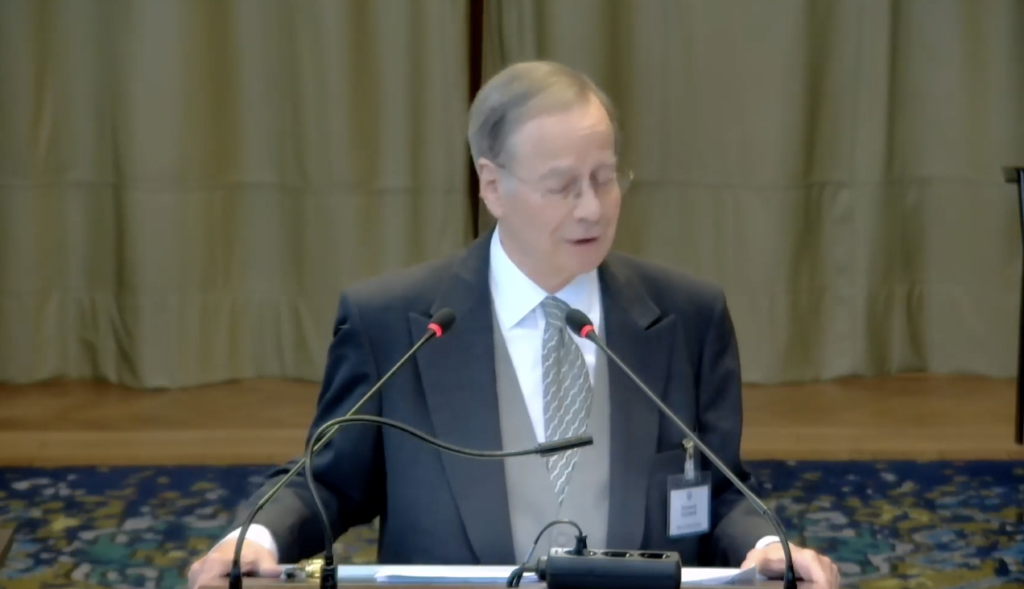
On the issue of the 1897 Treaty, Reichler reminded the Court that it was Venezuela that solicited the support of the US to secure arbitration, as he rubbished its contention that Great Britain and the US had colluded in favor of the former.
“Loyally reciting a client’s narrative is not evidence, and it is certainly not contemporaneous evidence. Where is the contemporaneous evidence from the late 19th century to support the argument that Great Britain and the United States defrauded or structurally coerced Venezuela to sign the 1897 Treaty, which is said to have been negotiated behind its back and contrary to its interests? Venezuela had the chance to present it in its written pleadings and did not. They had the chance again on Wednesday, and again, they did not. In fact, the evidence is entirely to the contrary,” the counsel said.
Guyana, through its legal team, has provided the ICJ with more than 27 different documents confirming that Venezuela wanted to go to arbitration with the British to determine title to the disputed territory.
When Great Britain failed to heed to its request for arbitration, Venezuela repeatedly urged the US to use its influence to compel the British to agree to arbitration. It was argued that the US not only agreed to assist Venezuela but later forced the British to agree to arbitration, even threatening to go to war if Britain had refused.
It was against that background that the 1897 Treaty of Washington was signed, Reichler argued, explaining that the treaty laid the foundation for the 1899 Arbitral Award, which established the land boundary between Venezuela and then British Guiana.
After more than 60 years of recognizing the validity of the 1899 award, and four years before Guyana gained independence, Venezuela disputed the award. The Geneva Agreement, signed on February 17, 1966, established a framework for the peaceful resolution of the controversy.
Related posts:
 Guyana to deliver second round of arguments in border case on Friday
 Guyana’s Legal Counsel rubbishes Venezuela’s objection to 1899 Arbitral Award that settled boundary dispute
 Guyana ready for ICJ hearing on border controversy on Tuesday
 Guyana files documents with International Court showing jurisdiction in Venezuela border row

You must be logged in to post a comment Login