









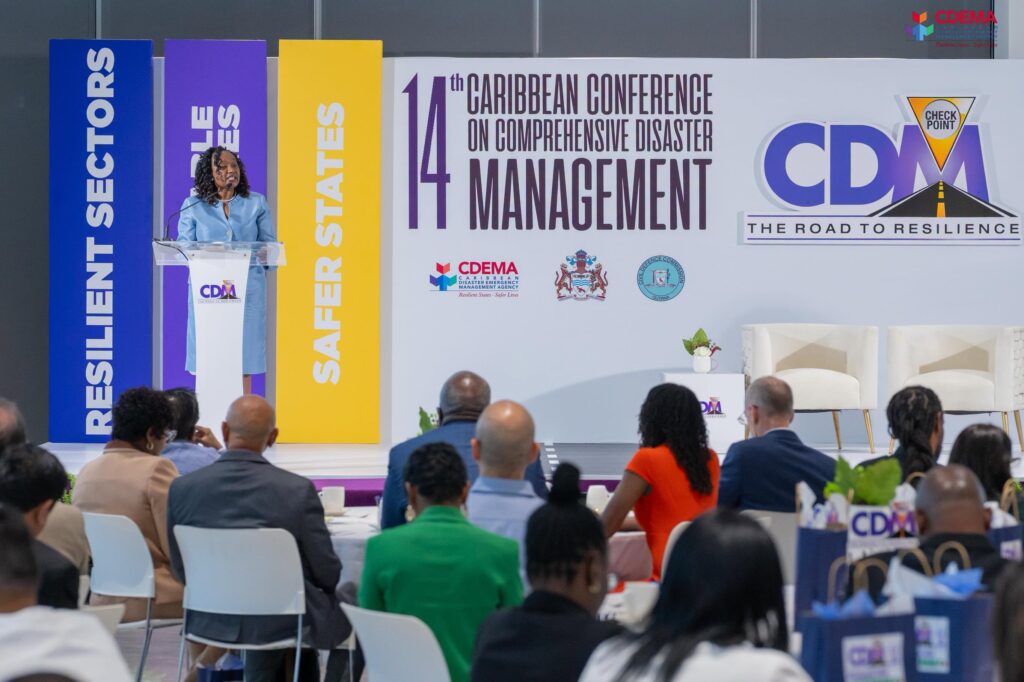
The 14th Caribbean Conference on Comprehensive Disaster Management which is set for December 7-12, will challenge the region to take stock of its ability to withstand environmental shocks amid resource constraints, Prime Minister Mark Phillips said as he delivered the keynote address during the launch of the conference on Tuesday at the Pegasus Suites.
Themed “Checkpoint 2026 – Resilient Sectors, Sustainable Communities, Safer States”, the region’s premier conference on Disaster Risk Management is being hosted by the Caribbean Disaster Emergency Management Agency (CDEMA), in conjunction with the Civil Defence Commission (CDC).
It will bring together policymakers, development partners, private sector leaders and technical experts to address the region’s most pressing resilience challenges.
Prime Minister Phillips said the theme challenges the Region to assess the readiness of its institutions, the progress made and the gaps that remain in combating climate change and natural disasters.
“We meet at a time of considerate pressure. As Caribbean States we are continuously contending with climate volatility, economic shocks, infrastructure vulnerabilities, public health threats, supply chain disruptions, and rapidly evolving technological and security risks. These pressures most time overlap and compound testing governments’ capacity to respond within ever shorter windows of time,” the Prime Minister said.
He said disaster management could no longer be treated as a function activated only after a disaster; adding that countries must anticipate threats before they mature; invest ahead of need, and coordinate across borders.
Countries, he said, must put in place resilient infrastructure.
Meanwhile, the Executive Director of CDEMA, Elizabeth Riley, said the conference is talking place at a critical time, and will unlock the next level of regional conversation on resilience and what it means for development, and the future.
“The Caribbean is confronting a rapidly changing and increasingly complex risks landscape shaped by diverse hazards including those of seismic, volcanic, geological and biological origins. Climate related hazards are becoming more frequent and more intense. And as climate impacts increase, so too do the costs,” Riley said.
Riley said Hurricane Melissa, which resulted in US$12.2 billion in damage and losses, is just the latest reminder that Caribbean States remain on the frontline of a climate crisis that it did not create.
Setbacks to development, reduced competitiveness and increasing pressures on public resources are just but a few of the catastrophic effects on countries, Riley said.
“Resilience must be understood as a strategic governance, development and economic imperative. It must shape how we plan, invest and govern. This is especially important as development financing becomes more constrained and official development assistance decline. Maximizing available resources, strengthening disaster risk financing and embedding resilience into investment decisions will be critical to safeguarding development gains,” Riley said.
Riley said over the last 25 years, the Comprehensive Disaster Management Strategy has placed sector leadership and empowerment at the center of resilience building, and since 2007, CDEMA has worked alongside education, agriculture, tourism, health and civil society partners to strengthen sector resilience.
The CDM Strategy to 2030 is expected to deepen the approach through expanded sector engagement with energy, water, the private sector and the stronger focus on finance, economic development and disaster risks management.
Director General of the Guyana Civil Defence Commission (CDC), Colonel (Retired) Nazrul Hussain said the impacts of climate change are now lived experiences, and require a shared strategic approach.
“We are enduring more intense rainfall, prolong droughts, stronger storms, coastal erosions, widespread flooding, wild fires, rising temperatures and wild fire and increasing threats to food security, water systems, energy infrastructure and public health. These are not Guyana’s problems alone, they are a regional burden, and they demand a shared and strategic response,” the CDC Director General said.
He said here in Guyana, the country has put systems in place to safeguard both its people and investments, and to ensure that the gains of development are not erased by disaster.
Substantial investments, he said, have been made in early warning systems, emergency preparedness infrastructure, hazard monitoring, climate adaptation framework and community resilience programmes, and Guyana stands ready to share its experiences with the rest of the region.
Related posts:
 Guyana to host major Caribbean Health Research Conference in April 2026
 Major UN Conference on Land Management and Impact of Climate Change opens in Guyana
 Guyana gears up to host major telecommunications conference and exhibition
 Guyana and rest of Caribbean aims to make region world’s first ‘climate smart zone’

You must be logged in to post a comment Login