









While continuing to question the jurisdiction of the International Court of Justice to hear the ongoing border case, Venezuela today said it does not believe that the ICJ can definitely settle the border controversy, arguing that the Geneva agreement does not cater for such an outcome.
Representing Venezuela in the proceedings, Professor Makane Moise Mbengue, argued that the Court ought not be dealing with the case.
“The 1899 award might be relevant, it may offer context, it is after all the wound that the Geneva agreement was designed to heal, but it certainly does not follow that the award should be permitted to stand in the way of a genuine resolution of the controversy between Guyana and Venezuela. Jurisdiction to entertain a question is not an obligation to answer it and certainly not an obligation not to answer it when doing so,” Mbengue told the ICJ.
On Monday, Guyana argued that the land boundary between the two countries was finally and definitively settled by the 1899 Arbitral Award and pointed out that the award is legally valid, binding, and should be respected.
But Mbengue, while wearing a pin of a map that incorporated Guyana’s Essequibo as part of Venezuela, said the real issue for Venezuela has never been about the 1899 award, which he described as discredited.
He told the ICJ Judges that in their first set of rulings, they did not take Venezuela’s main argument into account.
He said the Court’s findings of jurisdiction does not mean Guyana has a solid case. However, he said the Court must attend to the question of the Geneva agreement and not the 1899 arbitral award for a mutually satisfactory solution.
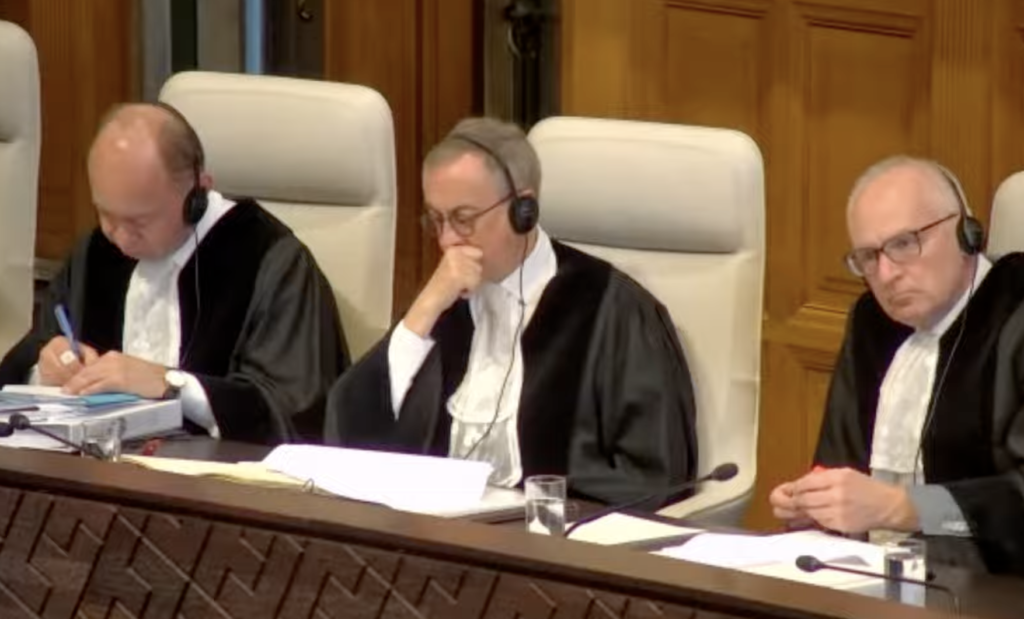
“That real issue is the pursuit of a mutually satisfactory agreement to the controversy generated by the 1899 award, a solution that consign this artifact of British imperialism to the past where it belongs and to chart a way forward, this is the only proper meaning of the Geneva agreement. It is as though so far, the only interpretation on the record, for the simple reason that Guyana has offered none,” Mbengue noted.
But even so, Mbengue wants the Court to address its mind to every aspect of the agreement.
“As a matter of law, the Court should not be constrained by the allegations that Guyana made, in particular it must carefully ascertain whether Guyana’s request, remains within the bounds of what the parties to the Geneva agreement has sought to resolve. Guyana’s claims cannot exist as they do, the framework established by the Geneva agreement nor can the court decide on those matters,”Mbengue argued.
Venezuela is advancing its position that the matter should be addressed through dialogue, while Guyana is asking the ICJ to definitively settle the controversy.
Related posts:
 International Court dismisses Venezuela’s objections to Guyana’s case on the border controversy
 Venezuela argues against International Court hearing Guyana’s border case
 ICJ rules it has jurisdiction in Guyana case against Venezuela over border controversy
 Guyana ready for ICJ hearing on border controversy on Tuesday

You must be logged in to post a comment Login